Rechercher dans ce blog

Monday, December 6, 2021

New consortium to advocate for novel food ingredient approval for allulose in EU and UK - Nutritional Outlook

Cosun Beet Company, Ingredion Inc., Matsutani Chemical Industry, and Samyang Corp. have formed a new consortium designed to help bring allulose to the European Union and United Kingdom, and support its nutritional labeling as a carbohydrate. The new consortium is called the Allulose Novel Food Consortium (ANFC).

Currently, allulose is authorized as a food ingredient in many countries worldwide, which include Japan, Mexico, Singapore, South Korea, and the United States, as well as under regulatory evaluation in other countries. The ingredient is also FEMA (Flavor Extract Manufacturers Association) GRAS (Generally Recognized As Safe) for use as a flavoring in beverages and milk products.

ANFC believes that a single, joint, proprietary European Union (EU and UK) novel food application would accelerate the approval process, saving time and money for members. Members also anticipate that approval of allulose as a novel food ingredient would benefit European and global food industries because it has potential beyond being a low-calories sweetener. EU approval could also prove influential to other international food regulators.

“Formation of the Allulose Novel Food Consortium is an exciting step forward towards accelerating more widespread use of allulose in Europe," said Shigehiro Hayashi of Matsutani Chemical, in a press release. "With our members combined knowledge and expertise in the science of healthy food and beverage ingredients, we aim to enable allulose to reach its true potential and recognize that this could help in achieving a reduction in calorie intake – a major public health initiative."

Those interested in joining the ANFC can reach out to Hayashi at shayashi@matsutani.co.jp.

Adblock test (Why?)


New consortium to advocate for novel food ingredient approval for allulose in EU and UK - Nutritional Outlook
Read More

Five-Ingredient Holiday Chocolate Bark Recipe - PureWow

1. Line a baking sheet with parchment paper. Place the semisweet chocolate in a medium heatproof bowl. In a medium saucepan, bring a few inches of water to a gentle simmer; nest the bowl in the saucepan and stir with a silicone spatula until fully melted. Repeat in a separate bowl with the white chocolate.

2. To the semisweet chocolate, stir in half of the pistachios and half of the cranberries. Spread the mixture into a thin, even layer on the prepared baking sheet. Drizzle all over with most of the white chocolate (hold back a small amount for a final drizzle), using a paring knife to swirl it through. Top with the remaining pistachios and cranberries, drizzle with the remaining white chocolate and garnish with flaky salt.

3. Allow the chocolate bark to set until completely firm, ideally overnight. (You can speed up the process by chilling in the refrigerator, but the chocolate may “bloom” or turn ashy looking—it’s still OK to eat, though.) Break the bark into bite-size pieces before serving.

Adblock test (Why?)


Five-Ingredient Holiday Chocolate Bark Recipe - PureWow
Read More

New Vaccine Ingredient May Battle COVID, Other Illnesses Including HIV: Study - Newsweek

A combination-style vaccine ingredient may help to make coronavirus vaccines and other inoculations more successful at staving off disease, according to a new study from researchers at the La Jolla Institute for Immunology (LJI) and Massachusetts Institute of Technology (MIT).

The study, which was published on December 3 in the journal Science Immunology, found that a new combination adjuvant—or type of ingredient that can allow vaccines to create a stronger immune response—may boost the effectiveness of inoculations ranging from HIV to COVID-19.

According to LJI, adjuvants act as "red flags" that lead the immune system to react more strongly to antigens and develop the necessary cells for the body to fight off disease.

For the study, scientists self-assembled a new type of adjuvant called SMNP using a combination of two molecules, known as saponin and TLR agonists.

According to the study, saponin adjuvants have already been approved for use in shingles vaccines, while TLR agonists are known for stimulating an immune response when an antigen is first detected.

When combined, the scientists found that the molecules work together to activate multiple levels of the immune system—which could ultimately help vaccines become even more protective against disease.

"[The] combination works so well because it activates so many different parts of the immune system," LJI said in a press release. "While saponin and the TLR agonist have their jobs, combining them also prompts the immune system to make more types of T follicular helper cells, which strengthen the immune response, and more interleukin-21, an antiviral molecule," it added.

The study was conducted on mice and appeared to be safe and effective so far. Researchers said the SMNP adjuvant still has a ways to go before it could be implemented in future vaccines, but they are hoping the ingredient could eventually help a range of inoculations.

"This is super exciting," said LJI Professor Dr. Shane Crotty, a member of the LJI Center for Infectious Disease and Vaccine Research. "We're really hoping this adjuvant can help out."

"This has, potentially, a big impact for human health," he added.

New Vaccine Ingredient May Help COVID shot
Scientists found that a new vaccine ingredient may help COVID-19 vaccines and other inoculations become more successful at fighting disease. Here, used vials of COVID-19 vaccines are seen at the Thornton Fire Department on March 6 in Thornton, Colorado. Michael Ciaglo/Getty Images

According to the LJI, the Food and Drug Administration (FDA) has only approved five adjuvants for use in the U.S. However, researchers on the study said it is imperative for scientists to continue developing and understanding these ingredients in order to create more effective vaccines.

"New adjuvants that help drive particular aspects of antibody or T cell-mediated immunity may be an important part of successfully developing vaccines against challenging pathogens such as HIV, TB, and malaria," added study co-leader and MIT professor Dr. Darrell Irvine.

According to the Centers for Disease Control and Prevention (CDC), adjuvants are currently used in vaccines to prevent diseases ranging from HPV, the flu, shingles and hepatitis B.

"Vaccines containing adjuvants are tested for safety and effectiveness in clinical trials before they are licensed for use in the United States, and they are continuously monitored by CDC and FDA once they are approved," the CDC said on its website.

Adblock test (Why?)


New Vaccine Ingredient May Battle COVID, Other Illnesses Including HIV: Study - Newsweek
Read More

New vaccine ingredient may create a stronger defense against many illnesses — including COVID-19 - myfox8.com

[unable to retrieve full-text content]

New vaccine ingredient may create a stronger defense against many illnesses — including COVID-19  myfox8.com
New vaccine ingredient may create a stronger defense against many illnesses — including COVID-19 - myfox8.com
Read More

New consortium to lobby for novel food ingredient approval for allulose in EU and UK - Nutritional Outlook

[unable to retrieve full-text content]

New consortium to lobby for novel food ingredient approval for allulose in EU and UK  Nutritional Outlook
New consortium to lobby for novel food ingredient approval for allulose in EU and UK - Nutritional Outlook
Read More

Ingredients with health, sustainability benefits win Fi Europe awards - Food Business News

FRANKFURT, GERMANY — Improving immune health, empowering women and enhancing sensory in baked foods were features of winning ingredients at the Fi Europe Innovation Awards, which were presented in a Dec. 1 ceremony at Fi Europe in Frankfurt. The awards recognize achievements in the food and beverage industry.

Bunge Loders Croklaan, a business of St. Louis-based Bunge Ltd., won the clean label and natural innovation award for its Karibon ingredient, a 100% shea-based cocoa butter equivalent (CBE) that combines the processing benefits and versatility of CBEs with the nutritional and sustainability benefits of shea.

“Until now, only blends of shea and palm oil were available as an alternative to cacao butter,” said Ing Renee Boerefijn, PhD, director of innovation for EMEA (Europe, Middle East and Africa) for Bunge Loders Croklaan. “With Karibon, we can offer a pure shea ingredient for chocolate bars, coatings and other applications. Our suppliers are women's cooperatives from West Africa who collect shea to provide additional income for their families. Our ingredient is clean label while contributing to environmental and social sustainability.”

AAK, Malmö, Sweden, took the sensory innovation award for its AkoBisc GO!, a biscuit fat low in saturated fatty acids and free from tropical fats. The ingredient offers a sensory biscuit quality with a crunchy bite, no fat bloom and no discoloration over time.

“This award recognizes the innovative strength of AkoBisc GO!, which not only scores in terms of sustainability, but also provides sensory enhancement of baked goods while significantly simplifying the various production steps,” said Alberto Rosado, global innovations manager bakery at AAK.

The plant-based innovation award went to Royal DSM nv, Heerlen, The Netherlands, for its Maxavor Fish YE, a natural fish flavor derived from algal oil for producing fish alternatives, including vegetarian fish nuggets and vegan fish sauce. The ingredient is available in two flavor profiles: Maxavor Fish M YE, which replicates the body, mouthfeel and taste of rich and oily dark fish, and Maxavor Fish W YE, which emulates fresh, light and fleshy white fish.

The FreshQ food cultures from Chr. Hansen, Hoersholm, Denmark, received the food tech innovation award. The cultures remove the main technical barrier for implementing fermentation-enabled bio-protection to help reduce food waste.

“We are very happy that the jury of food experts acknowledges the game-changing qualities of our next-generation of FreshQ,” said Marianne Gregersen, commercial development manager for Chr. Hansen. “This innovation brings fermentation-enabled bio-protection to the dairy producers, who need it the most, making it possible to fight food waste in regions where cold chains can be challenged.”

NutriLeads, Wageningen, The Netherlands, won the health innovation award for BeniCaros, a proprietary ingredient for immune health clinically proven to support and optimize immune function and response.

“We are a small team and have only been on the market since 2012,” said Erik Dam, chief executive officer at NutriLeads. “The fact that we now hold an Fi Innovation Award in our hands with our very first product is wonderful recognition of our efforts. BeniCaros is derived from byproducts of carrot juice production and scientifically proven to accelerate the immune response, therefore addressing several consumer trends at once."

NZMP, Auckland, New Zealand, the ingredients brand of dairy cooperative Fonterra, received the sustainability innovation award for its organic butter, a Carbonzero-certified ingredient. Carbonzero measures greenhouse gas and how to reduce emissions.

Adblock test (Why?)


Ingredients with health, sustainability benefits win Fi Europe awards - Food Business News
Read More

Secret Ingredient For 3D-Printed Circuit Traces: Electroplating - Hackaday

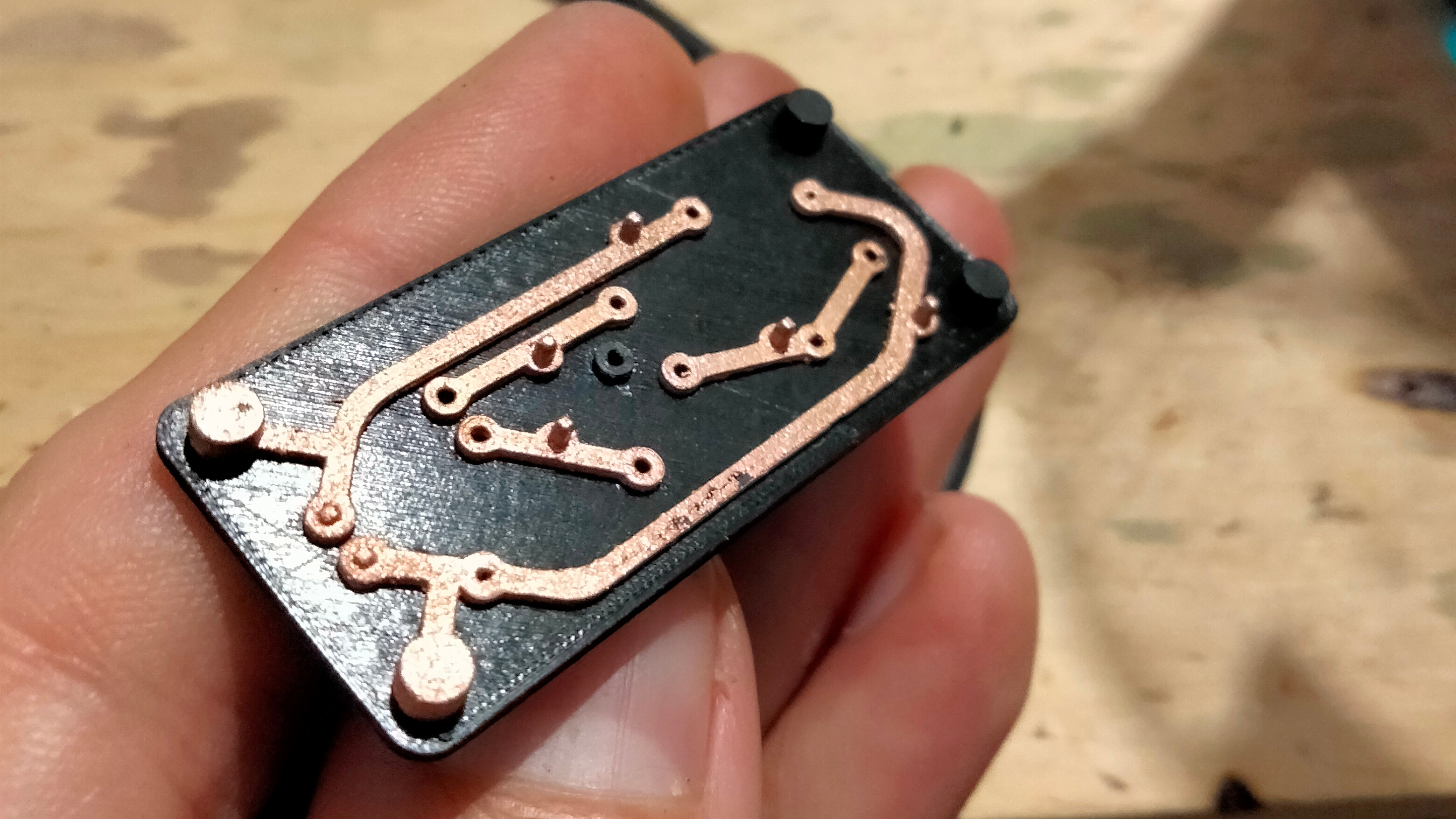
Conductive filament exists, but it takes more than that to 3D print something like a circuit board. The main issue is that traces made from conductive filament are basically resistors; they don’t act like wires. [hobochild]’s interesting way around this problem is to use electroplating to coat 3D-printed traces with metal, therefore creating a kind of 3D-printed circuit board. [hobochild] doesn’t yet have a lot of nitty-gritty detail to share, but his process seems fairly clear.

The usual problem with electroplating is that the object to be coated needs to be conductive. [hobochild] addresses this by using two different materials to create his test board. The base layer is printed in regular (non-conductive) plastic, and the board’s extra-thick traces are printed in conductive filament. Electroplating takes care of coating the conductive traces, resulting in a pretty good-looking 3D-printed circuit board whose conductors feature actual metal. [hobochild] used conductive filament from Proto-pasta and the board is a proof-of-concept flashing LED circuit. Soldering might be a challenge given the fact that the underlying material is still plastic, but the dual-material print is an interesting angle that even allows for plated vias and through-holes.

We have seen conductive filament used to successfully print workable electrical connections, but applications are limited due to the nature of the filament. Electroplating, a technology accessible to virtually every hacker’s workbench, continues to be applied to 3D printing in interesting ways and might be a way around these limitations.

Adblock test (Why?)


Secret Ingredient For 3D-Printed Circuit Traces: Electroplating - Hackaday
Read More

In Jamie Oliver's newest cookbook, you don't need many ingredients to make a delicious meal - WBUR News

You don’t need a ton of obscure ingredients to cook up a delicious meal. That’s the crux of chef and restauranteur Jamie Oliver ’s new cook...