Rechercher dans ce blog

Tuesday, April 4, 2023

Popular Easter candy called out for containing cancer-causing ingredient - FOX 10 News Phoenix

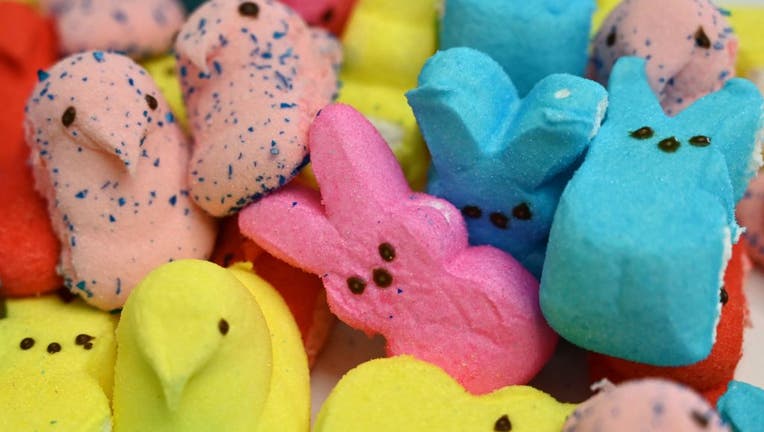
This illustration shows Peeps marshmallows laying on a table in Washington, DC on April 2, 2021. (Photo by Eva Hambach/AFP via Getty Images)

An Easter sweets staple is under fire for a concerning ingredient.

Peeps are currently being called out for containing Red Dye 3, a known carcinogen, according to studies by the National Institutes of Health (NIH).

This includes Peeps Pink Marshmallow Chicks, Peeps Pink Marshmallow Bunnies, Peeps Lavender Marshmallow Chicks and Peeps Lavender Marshmallow Bunnies, according to Consumer Reports.

CALIFORNIA PROPOSES BILL TO BAN SOME FOOD PRODUCTS WHILE NUTRITIONISTS FRET ABOUT ‘GROSS’ INGREDIENTS

Other Just Born products containing Red Dye 3 include Hot Tamales candy, Peeps Hot Tamales Marshmallow Chicks, Party Cake Peeps, Peeps Fruit Punch Marshmallow Chicks and Peeps Wildberry Marshmallow Bunnies.

Earlier this year, nonprofit Consumer Reports called on Peeps manufacturer Just Born to end the use of Red Dye 3 in its products, according to a press release issues on Monday, April 3.

Consumer Reports said that it did not receive a response from Just Born, nor has the manufacturer announced plans to change its processes.

Senior staff scientist for Consumer Reports Michael Hansen, PhD, wrote in a statement that parents should know "purple and pink colored Peeps they may be putting in their kids’ Easter basket are made with an ingredient that is a known carcinogen."

AMERICANS' FAVORITE EASTER CANDIES AND PASSOVER FOODS REVEALED: INSTACART SURVEY

"Just Born Quality Confections should stop making its iconic marshmallow treats with this dangerous food chemical since other less risky alternatives are readily available," he said.

In response to a query from Fox News Digital, Just Born on Monday sent along a statement, writing in an email that "FD&C Red #3 is currently an approved colorant for use in candy by the FDA."

"We manufacture all our candies in compliance with FDA regulations, sourcing our ingredients and packaging exclusively from reputable suppliers who adhere to high quality and safety standards," the company said. 

"We also provide consumers with information on our packaging and our websites to help them make informed choices about our products."

PEPSI, PEEPS DOING LIMITED-TIME RELEASE OF MARSHMALLOW SODA IN STORES ACROSS COUNTRY

The manufacturer also wrote that its product development team is "continually exploring opportunities to provide expanded options for our consumers, including colors derived from natural sources that can deliver the same visual impact and stability as their certified counterparts."

The callout of Peeps follows a newly proposed bill from the California State Legislature that would ban the sale of food products such as Skittles, Pez and other items due to their reportedly harmful additives.

These additives include brominated vegetable oil, potassium bromate, propylparaben, titanium dioxide and Red Dye 3, according to the proposal.

"Californians shouldn’t have to worry that the food they buy in their neighborhood grocery store might be full of dangerous additives or toxic chemicals," said Jesse Gabriel, an assembly member, in a statement.

Consumer Reports joined the Center for Science in the Public Interest in October to urge the FDA to ban Red Dye 3 from all food products.

The organization delivered a petition to the FDA on Monday, signed by nearly 35,000 consumers, calling for the prohibition of these cancer-causing chemicals in foods.

Some artificial colors in foods have also been linked to adverse effects on the attention and activity levels in children, as well as allergic reactions, according to WebMD.

There are more than 2,900 food products on the market that contain Red Dye 3, according to Environmental Working Group. 

Hansen of Consumer Reports mentioned that while the FDA has banned the use of Red Dye 3 in cosmetics since 1990, it "inexplicably is still allowed in food."

BOB BORN, CANDY EXECUTIVE AND ‘FATHER OF PEEPS,' DEAD AT 98

"The widespread use of Red Dye 3 is particularly concerning since it is found in many products marketed to children who are especially at risk of developing health problems from exposure," he said. 

"It’s time for the FDA to protect public health by getting Red Dye 3 out of our food."

Registered dietitian and nutritionist Ilana Muhlstein agreed, suggesting that the FDA has the "power to help" in an email sent to Fox News Digital.

"The FDA has the power to help reduce the risk of cancer in the U.S. by clearing the U.S. food system of several known harmful ingredients but, instead, chooses not to," she said.

"What is alarming is that it seems, from public perception, that the FDA is standing in greater defense of American candy and food companies than they are of the U.S. population," she also said. "It calls into question the potential conflicts of interest at hand."

While cancer is one of the leading causes of death for children in the U.S. — with obesity impacting 20% of children ages six to 11, according to CDC statistics — Muhlstein suggested it should be intuitive for the FDA to deploy "tighter control over food manufacturers."

"We should feel safe knowing that the food on our shelves, and marketed to children, in the U.S. is the food we can feel good about consuming." 

As harmful ingredients are taking a "noticeable toll on our declining cognitive and physical health," Muhlstein said that in her view, the FDA needs to "step up and further protect Americans by banning Red Dye 3 and other questionable ingredients in our food supply to preserve their credibility as a health organization." 

The FDA did not immediately respond to Fox News Digital's request for comment.

Read more from FOX Business

Adblock test (Why?)


Popular Easter candy called out for containing cancer-causing ingredient - FOX 10 News Phoenix
Read More

Warning: Popular Easter Candy Contains Ingredient Linked to Cancer (And Is Still For Sale) - TheStreet

Popular Easter candy called out for containing cancer-causing ingredient - Fox Business

An Easter sweets staple is under fire for a concerning ingredient.

Peeps are currently being called out for containing Red Dye 3, a known carcinogen, according to studies by the National Institutes of Health (NIH).

This includes Peeps Pink Marshmallow Chicks, Peeps Pink Marshmallow Bunnies, Peeps Lavender Marshmallow Chicks and Peeps Lavender Marshmallow Bunnies, according to Consumer Reports.

CALIFORNIA PROPOSES BILL TO BAN SOME FOOD PRODUCTS WHILE NUTRITIONISTS FRET ABOUT ‘GROSS’ INGREDIENTS

Other Just Born products containing Red Dye 3 include Hot Tamales candy, Peeps Hot Tamales Marshmallow Chicks, Party Cake Peeps, Peeps Fruit Punch Marshmallow Chicks and Peeps Wildberry Marshmallow Bunnies.

Earlier this year, nonprofit Consumer Reports called on Peeps manufacturer Just Born to end the use of Red Dye 3 in its products, according to a press release issues on Monday, April 3.

pink bunny peeps

Consumer Reports is calling for cancer-causing Red Dye 3 to be removed from products like pink-colored Peeps manufactured by Just Born. (Angelica Stabile/Fox News Digital / Fox News)

Consumer Reports said that it did not receive a response from Just Born, nor has the manufacturer announced plans to change its processes.

Senior staff scientist for Consumer Reports Michael Hansen, PhD, wrote in a statement that parents should know "purple and pink colored Peeps they may be putting in their kids’ Easter basket are made with an ingredient that is a known carcinogen."

AMERICANS' FAVORITE EASTER CANDIES AND PASSOVER FOODS REVEALED: INSTACART SURVEY

"Just Born Quality Confections should stop making its iconic marshmallow treats with this dangerous food chemical since other less risky alternatives are readily available," he said.

In response to a query from Fox News Digital, Just Born on Monday sent along a statement, writing in an email that "FD&C Red #3 is currently an approved colorant for use in candy by the FDA."

peeps marshmallows

Assorted Peeps marshmallows are shown on a table in Washington, D.C., on April 2, 2021.  (EVA HAMBACH/AFP via Getty Images / Getty Images)

"We manufacture all our candies in compliance with FDA regulations, sourcing our ingredients and packaging exclusively from reputable suppliers who adhere to high quality and safety standards," the company said. 

"We also provide consumers with information on our packaging and our websites to help them make informed choices about our products."

PEPSI, PEEPS DOING LIMITED-TIME RELEASE OF MARSHMALLOW SODA IN STORES ACROSS COUNTRY

The manufacturer also wrote that its product development team is "continually exploring opportunities to provide expanded options for our consumers, including colors derived from natural sources that can deliver the same visual impact and stability as their certified counterparts."

The callout of Peeps follows a newly proposed bill from the California State Legislature that would ban the use of Red Dye 3 and other harmful additives.

These other additives include brominated vegetable oil, potassium bromate, propylparaben and titanium dioxide, according to the proposal.

"Californians shouldn’t have to worry that the food they buy in their neighborhood grocery store might be full of dangerous additives or toxic chemicals," said Jesse Gabriel, an assembly member, in a statement.

Consumer Reports joined the Center for Science in the Public Interest in October to urge the FDA to ban Red Dye 3 from all food products.

The organization delivered a petition to the FDA on Monday, signed by nearly 35,000 consumers, calling for the prohibition of these cancer-causing chemicals in foods.

pink peeps ingredients

The back of a package of pink Peeps bunnies lists Red Dye 3 as an ingredient per FDA requirement. (Angelica Stabile/Fox News Digital / Fox News)

Some artificial colors in foods have also been linked to adverse effects on the attention and activity levels in children, as well as allergic reactions, according to WebMD.

There are more than 2,900 food products on the market that contain Red Dye 3, according to Environmental Working Group. 

Hansen of Consumer Reports mentioned that while the FDA has banned the use of Red Dye 3 in cosmetics since 1990, it "inexplicably is still allowed in food."

BOB BORN, CANDY EXECUTIVE AND ‘FATHER OF PEEPS,' DEAD AT 98

"The widespread use of Red Dye 3 is particularly concerning since it is found in many products marketed to children who are especially at risk of developing health problems from exposure," he said. 

"It’s time for the FDA to protect public health by getting Red Dye 3 out of our food."

peeps variety packages

A display of marshmallow Peeps in a variety of flavors and styles such as Hot Tamales and Fruit Punch, in the Easter Candy section of the Port Clinton Peanut Shop in Port Clinton, Pennsylvania, on March 18, 2021. (Ben Hasty/MediaNews Group/Reading Eagle via Getty Images / Getty Images)

Registered dietitian and nutritionist Ilana Muhlstein agreed, suggesting that the FDA has the "power to help" in an email sent to Fox News Digital.

"The FDA has the power to help reduce the risk of cancer in the U.S. by clearing the U.S. food system of several known harmful ingredients but, instead, chooses not to," she said.

GET FOX BUSINESS ON THE GO BY CLICKING HERE

"What is alarming is that it seems, from public perception, that the FDA is standing in greater defense of American candy and food companies than they are of the U.S. population," she also said. "It calls into question the potential conflicts of interest at hand."

While cancer is one of the leading causes of death for children in the U.S. — with obesity impacting 20% of children ages six to 11, according to CDC statistics — Muhlstein suggested it should be intuitive for the FDA to deploy "tighter control over food manufacturers."

ilana muhlstein rdn

Registered dietitian and nutritionist Ilana Muhlstein said the FDA has the "power to help" the public's health.  (Ilana Muhlstein / Fox News)

"We should feel safe knowing that the food on our shelves, and marketed to children, in the U.S. is the food we can feel good about consuming." 

As harmful ingredients are taking a "noticeable toll on our declining cognitive and physical health," Muhlstein said that in her view, the FDA needs to "step up and further protect Americans by banning Red Dye 3 and other questionable ingredients in our food supply to preserve their credibility as a health organization." 

An FDA spokesperson responded to FOX Business regarding these additives.

CLICK HERE TO SIGN UP FOR OUR LIFESTYLE NEWSLETTER

"The FDA is actively reviewing a petition filed for FD&C [Food, Drug and Cosmetic Act] Red No.3," the spokesperson said in an emailed statement.

"We should feel safe knowing that the food on our shelves, and marketed to children, in the U.S. is the food we can feel good about consuming," said registered dietitian Ilana Muhlstein. (iStock / iStock)

" FD&C Red No. 3 has been previously evaluated by the FDA," the statement continued, noting that it is regulated by the FDA as a "color additive."

The spokesperson added, "The FDA has two authorizing color additive regulations, one for food and one for ingested drugs."

The statement also said that the color additive "Red No. 3" is a "certified color."

CLICK HERE TO READ MORE ON FOX BUSINESS

The FDA requires all color additives to be listed on product labels so that they can be identified by consumers, the FDA continued, adding that "consumers who wish to limit the amount of color additives in their diets may check the food ingredient list on labels."

Adblock test (Why?)


Popular Easter candy called out for containing cancer-causing ingredient - Fox Business
Read More

Monday, April 3, 2023

Finally, MSG Is No Longer the Bad Guy - The Takeout

Platter of garlic knots

Monosodium glutamate (or MSG) has been undergoing a notable shift within the food landscape over the past few years, and it’s about damn time. You have no doubt heard the harmful gossip  that has swirled around this controversial ingredient for most of the past century; maybe you’ve even been told to outright avoid consuming it. Because decades of misinformation have left the public wondering whether MSG is safe to eat, fans of the ingredient have had their work cut out for them, assuring everyone that MSG is perfectly safe and delicious (and it is!). Thanks to those efforts, MSG’s public image has finally started to shift.

MSG is increasingly embraced by chefs and home cooks

According to a report from market research firm Mintel, the social media conversation around MSG has recently become more positive: Between 2018 and 2023, 75% of social media posts that were reviewed contained positive sentiment toward MSG. The report also suggests that brands that actively work to destigmatize the ingredient while advocating against racial stereotypes are likely to be viewed favorably by consumers.

The report highlights brands such as Omsom, a company that sells flavor kits for cooking Asian dishes at home. Omsom’s product is just one example of how businesses can help reshape the story of MSG and aid the public’s understanding of all it can do. Chefs, too, are openly embracing the ingredient as a flavor enhancer in their kitchens (as highlighted in this CBS segment) after years of avoiding MSG discourse for fear of losing customers.

MSG’s bad reputation is even being dismantled in arenas such as the dictionary itself. In 2020, Merriam-Webster revised the label on its entry for the term “Chinese restaurant syndrome,” noting that the phrase is “dated” and “sometimes offensive.” The definition is now also linked to another term, “MSG symptom complex,” which describes the symptoms some people experience after consuming MSG and attribute to the presence of the ingredient.

“While there are numerous anecdotal reports of MSG symptom complex, research has failed to establish a clear, definitive link between the consumption of MSG and adverse reactions,” Merriam-Webster notes in the entry.

How to use MSG in home cooking

I always keep a few shakers of MSG on hand, and if you’re interested in trying it out, it’s almost certainly available at your local grocery store. (I use Ajinomoto or Ac’cent.) It’s something I use to bolster savoriness in dips, sauces, and soups, and once you get familiar with its uses, it’s a tool you’ll find yourself reaching for on a regular basis. In conjunction with salt, MSG will coax some great additional flavor from whatever you’re making, and a little goes a long way.

If despite all these reassurances the idea of MSG still worries you, think about what you already eat on a regular basis, especially when it comes to snacks. If you’re a fan of Doritos, Cheetos, Pringles, or pretty much any fast food, congratulations, you’re in the habit of consuming small amounts of MSG. Look at the ingredient list for mass-produced salty packaged foods and you’ll probably see MSG pop up more often than you’d expect.

We can only hope that in the coming years the discourse around MSG relaxes even further. While many American consumers have finally started to come around to the fact that it’s just one more useful ingredient to keep in the pantry—one that tastes really good—there are millions of people left to enlighten. They’re just catching up, that’s all.

Adblock test (Why?)


Finally, MSG Is No Longer the Bad Guy - The Takeout
Read More

Sunday, April 2, 2023

2-Ingredient Chocolate Fudge Cake (Flourless) - Elavegan | Recipes

[unable to retrieve full-text content]

2-Ingredient Chocolate Fudge Cake (Flourless)  Elavegan | Recipes
2-Ingredient Chocolate Fudge Cake (Flourless) - Elavegan | Recipes
Read More

What Is Heme? The Lowdown on Impossible Foods' Not-So-Secret Ingredient - VegNews

If you’ve ever bitten into an Impossible Burger, you’ve likely been pretty blown away by just how meaty it is. How can a burger made from plants, with zero animal products, taste that close to a real beef patty? Well, according to Impossible Foods, the answer is in one key ingredient: heme. It sounds unfamiliar, and you’re unlikely to see it listed on the back of any other products you can find in the supermarket. But it’s actually pretty common. In fact, heme is in every living thing on the planet. But while it may be Impossible Food’s signature—and the reason its realistically meaty products have been picked up by major chains, like Burger King—it’s also been a source of controversy for the California-based food-tech company. Here’s what you need to know.

What is heme?

All living cells, in plants and animals, contain heme, which is a group of molecules that contain iron. It is a key part of a protein called hemoglobin and helps with many important processes, including oxygen transportation. Because of its color, heme is also the reason that blood from animals and humans is red. 

Does heme make meat taste like meat?

Impossible Foods’ overarching goal is to take animals out of the food system and replace them with plants. Animal agriculture is unsustainable: it’s a major source of greenhouse gas emissions and it drains the earth of vital resources, like water and land. But it’s also unethical. Every year, billions of animals are raised on industrial factory farms for the food industry.

So the brand came up with a solution: plant-based meat that doesn’t just taste close to the real thing, but that is almost identical to the real thing. But in order to accomplish this goal and get plants to taste like meat, Impossible Foods’ founder Pat Brown had to figure out what actually makes meat taste like meat. And because animals have high levels of hemoglobin in their muscles, he landed on heme.

“Heme catalyzes very specific types of chemical reactions that transform abundant, simple nutrients into this explosion of hundreds of diverse volatile odorant molecules,” Brown told the American Society for Microbiology in 2019. “When you experience them, together they add up unmistakably to the smell and taste of meat.”

VegNews.ImpossibleFoodsGuideImpossible Foods

Can heme be vegan?

But as we mentioned before, heme isn’t just in animals. It’s found in all living things, which includes plants. Impossible Foods started its food-tech journey by extracting heme from leghemoglobin found in the root nodules of soybeans. But over time, its process became more efficient and sophisticated. Now, Impossible Foods takes DNA from soybeans and inserts it into a genetically-engineered yeast, which is then fermented to produce heme.

This means that Impossible Foods’ heme is vegan, but it also means that, unlike many other plant-based brands on the market, its products are not GMO-free.

Impossible Foods & heme controversy

Because of the GMO situation, many have taken against Impossible Foods’ products. The Non-GMO Project, a certification organization that maintains the food system should be non-GMO, has criticized the brand in the past, alongside environmental organization Friends of the Earth and the Center for Food Safety. In 2021, the latter took things a step further when it filed a lawsuit challenging the FDA’s approval of heme in the first place.

According to the Center, there were not enough long-term tests carried out on Impossible Foods’ heme before it was given the green flag. “[The] FDA approved soy leghemoglobin even though it conducted none of the long-term animal studies that are needed to determine whether or not it harms human health,” Ryan Talbott, one of its attorneys, said in a statement at the time.

Despite the company’s and Brown’s moral stance against animal testing, Impossible Foods was forced to conduct one test on rats to receive approval from the FDA (Brown stated that without the test, “the mission and the future of billions of animals whose future depends on its success was thwarted”). Ultimately, the court concluded that this testing and the FDA’s approval process were sufficient, and the Center for Food Safety’s appeal was not successful.

“We applaud the court’s decision to recognize and uphold the FDA’s assessment of the abundant evidence supporting the safety of our product and to deny the meritless petition of the Center for Food Safety,” said Rachel Konrad, Impossible Foods’ chief communications officer, in a statement.

However, the company is still faced with several legal obstacles. As of right now, Impossible Foods can not legally sell products with heme in Europe or the UK, as it is yet to obtain regulatory approval (it has launched in the UK, but only with products that do not feature heme). The approval process is underway, but a decision from the UK Food Standards Agency and the European Food Safety Authority has not yet been given.

VegNews.ImpossibleFoodsBobsBurgersImpossible Foods

Do any other plant-based brands use heme?

Impossible Foods is currently the only plant-based brand on the market to use heme. But that could change. In 2020, Chicago-based startup Back of the Yards Algae Sciences (BYAS) figured out how to extract heme from spirulina, a type of blue-green algae.

According to the food-tech specialists, the discovery accidentally happened while researchers were studying how to create purple coloring using spirulina. But it could have major consequences for the plant-based industry, as the startup intends to sell the spirulina heme, which is non-GMO, to existing alternative protein brands.

The heme has already been put to the test, with promising results. In 2021, a review published in The Spoon by food writer Josh Schonwald compared two plant-based burgers before and after they were sprayed with BYAS’ spirulina heme.

“The heme-sprayed burgers were a clear upgrade,” he wrote. “In fact, I was so impressed with the heme’s flavoring that I tested the burger on the biggest mock-meat skeptic I know: my 11-year-old son.”

“As expected, Max shot a frown and yuck look after trying the standard Beyond [Meat burger],” he continued. “But after being persuaded to take one bite of the heme-sprayed version, Max had a shocking response. No frown. In fact, he said, ‘It’s pretty good.’”

So, very soon, Impossible Foods could face a fair amount of competition. In 2022, BYAS received investment from the DIC Corporation, a Japanese fine chemicals company and spirulina production pioneer, to help make its goal of selling the spirulina heme to plant-based brands a reality. 

For more on plant-based meat, read:

Adblock test (Why?)


What Is Heme? The Lowdown on Impossible Foods' Not-So-Secret Ingredient - VegNews
Read More

Ingredient of the week: Broccoli - The Spinoff

Don’t let broccoli’s virtuous goody two-shoes reputation put you off – these verdant and versatile florets make the perfect addition to tray bakes, salads, soups and more.

I reckon broccoli’s “superfood” status has given it a bit of a bad reputation. Because it’s so healthy (and reasonably inoffensive), its nutrients are all we want it for – we’ve made broccoli one-dimensional, the bland soulmate of steamed chicken. It’s a shame, because broccoli is actually quite versatile and open to being delicious.

But I won’t lie – broccoli is very healthy. A 100g serving of broccoli only has 34 calories, but provides 107% of your daily dose of vitamin C, 97% of vitamin K, as well as a decent dose of B vitamins when eaten raw. Tech millionaire Bryan Johnson, who is on a quest to reverse his ageing, eats “a few pounds” of broccoli and cauliflower early each morning. See, even writing that makes me see broccoli in a less yummy light. 

To combat that dreary health vibe, here’s some fun broccoli info. While it seems obvious once you think about it, I was quite delighted by the thought that the ends of a broccoli floret are actually tiny flower buds. If left unharvested, these buds can bloom into yellow flowers – so when you eat broccoli, you’re eating a bouquet. 

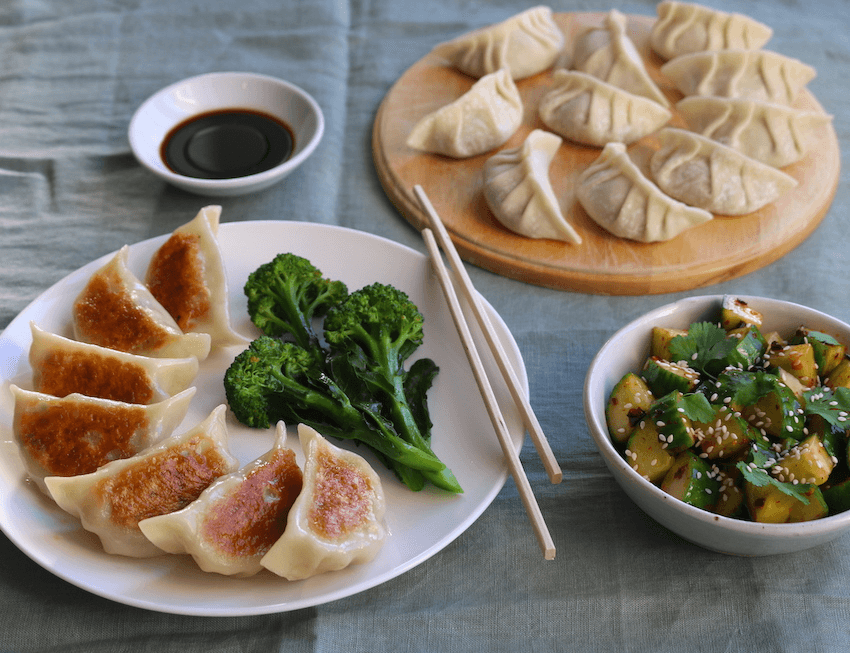
A plate of fried dumplings beside a small pile of brocolli. Surrounding the plate are a small bowl of dipping sauce, a plate of freshly-made dumplings and a bowl of Chinese cucumber salad with coriander and sesame seeds.
Fried dumplings with a side of brocolli. (Image: Wyoming Paul)

I always think of broccoli as simply “broccoli”, but there are actually all sorts of variations, and they have some brilliant names – for example, you could serve your bland steamed chicken with a side of Blue Wind, Coronado Crown, Destiny, Green Goliath, Green Magic, or Sun King. 

Then there’s broccoli’s fancy cousin, broccolini. What makes it fancy? Is it just its sweet slender limbs, which makes it look more elegant on a plate? Actually, Google tells me, broccolini is a hybrid of broccoli and gai lan (aka Chinese broccoli, another brassica), which was developed over eight years in Japan. That is fancy. 

Broccoli is also the word I most often misspell. I mean…almost every time. 

Where to find broccoli

Autumn means broccoli is back in business. A head of broccoli is $3.79 at New World, $3.49 at Supie, or $3 at both Pak’nSave and Countdown. For those hosting a fancy dinner party, broccolini is $3.99 at Countdown and $4.49 at Supie.

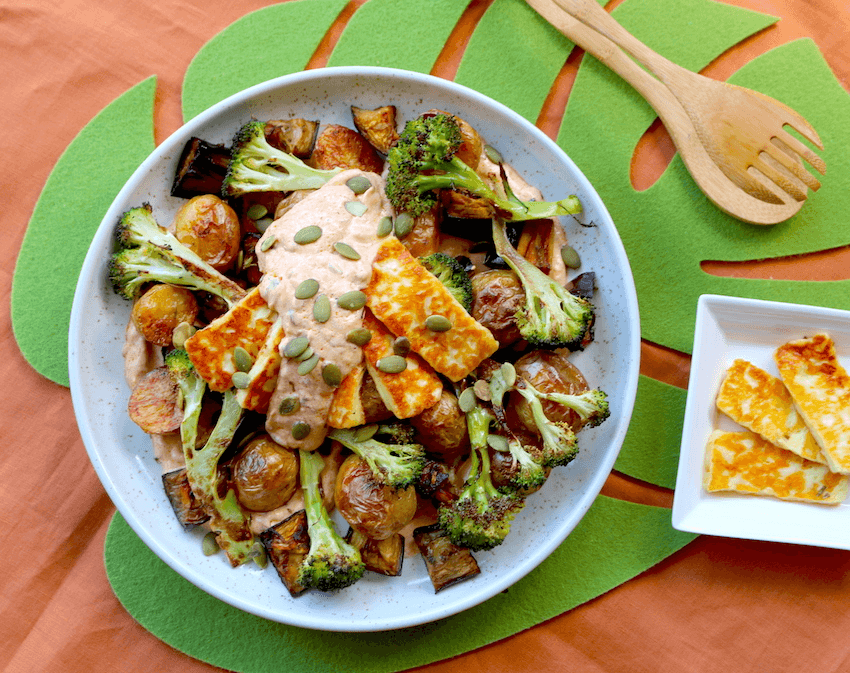
A bird's eye view of grilled haloumi atop a bowl of roasted potato, eggplant and broccoli. The plate is scattered with pumpkin seeds. The dish is displayed on top of a green monstera leaf placemat and a peach-coloured table cloth.
Halloumi tray bake with broccoli. (Image: Wyoming Paul)

How to make broccoli terrible

Boiling for a few minutes too long is a sure-fire way to ruin this well-meaning brassica. Soft, soggy and waterlogged is not what broccoli is meant to be, and boiling also diminishes the health benefits – steaming, stir-frying, even microwaving better preserve its goodness. If you’re boiling or steaming broccoli, always keep a close eye on your pot. It only needs two or three minutes, until bright green but still quite crisp. 

The other ruination option? Not using your broccoli quickly enough. Broccoli doesn’t keep very well, so should ideally be used within a few days of getting popped in the fridge. To extend its shelf life, you can bundle your broccoli with damp paper towels and stash it in a ziplock bag. 

How to make broccoli amazing

As well as a welcome visitor in stir fries, curries and on the side of almost anything (just in the last week, I have served steamed broccoli with dumplings, crispy curry fish bites, and Kung Pao chicken), there are some slightly more creative ways to use broccoli. 

Roasting broccoli is one of my favourite cooking methods; it becomes lightly charred, crunchy in places, and develops a lovely smokiness. You can add it to any vegetable tray bake, during the last 15 minutes of roasting. I recently paired charred broccoli with roasted baby potatoes and eggplant, fried halloumi, and a spicy Greek yoghurt sauce – divine. 

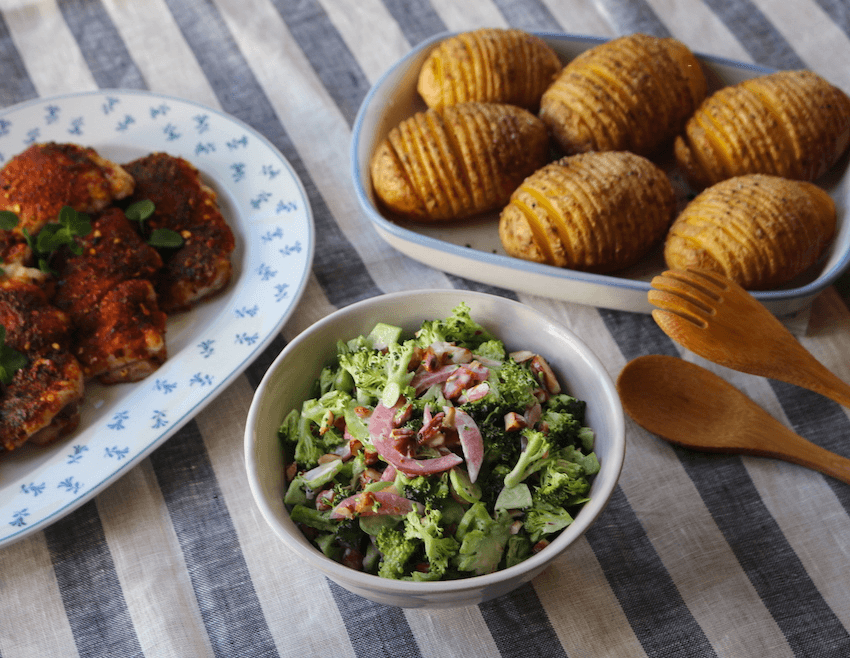
A bowl of raw broccoli salad next to a platter of six hasselback potatoes. The food is served on a striped tablecloth.
Raw broccoli salad with hasselback potatoes. (Image: Wyoming Paul)

Then there’s soup. Last year in winter I started really getting into blended vegetable soups, and broccoli and cheddar soup was one of my absolute top favourites. In most cases for me, soup is simply a dip or accompaniment to buttered crunchy toast. This soup really stands on its own, however, and I’d happily eat it toastless. 

Finally, you can make this really easy, really delicious raw broccoli salad, which I paired with roast hasselback potatoes and paprika chicken thighs. Simply finely chop the raw broccoli (including the stem and leaves), then toss with a lemon juice and mayonnaise dressing, finely sliced red onion, and roasted and chopped almonds. Perfect in the depths of winter when you’re craving a fresh green salad, but lettuces are still months away. Not that we’re there yet – even if shivering out of bed this morning felt like it.

Wyoming Paul is the co-founder of Grossr, and runs a weekly meal plan that connects to online supermarket shopping.

Read all the previous Ingredients of the Week here.

Adblock test (Why?)


Ingredient of the week: Broccoli - The Spinoff
Read More

In Jamie Oliver's newest cookbook, you don't need many ingredients to make a delicious meal - WBUR News

You don’t need a ton of obscure ingredients to cook up a delicious meal. That’s the crux of chef and restauranteur Jamie Oliver ’s new cook...