Splashing water on to coffee beans before grinding could be the secret to making the perfect cup of coffee, a study has found.
It is a common technique favoured by baristas hoping to keep their station tidy, as the water creates less bean mess – but it was never proven to boost taste.
Now, a study from Oregon University which drew on the science of volcanic activity has found spraying water on beans before putting them in the grinder reduces the amount of static electricity on the particles as they pass through the machine.
This not only reduces clumping and makes clean-up easier, but it also creates a finer dust which increases surface area and therefore allows for more flavour to be extracted from the beans.
Dr Christopher Hendon, associate professor of chemistry at the University of Oregon, set up a coffee lab on his campus two years ago and volcanologist Josh Méndez Harper was a regular visitor.
Dr Méndez Harper realised that there were, as unlikely as it may seem, similarities between the grinding of coffee beans and a volcanic eruption.
Ash and rocks create static
His expertise in the movement of molten rock, geological activity and rising magma meant he knew that when ash and rocks spewed out of a volcano they rubbed together and create static which can result in lightning strikes.
“It is similar to grinding coffee, where you’re taking these beans and reducing them to fine powder,” he said.
The pair investigated if the process of spraying water on to the beans before grinding can stop the static forming.
They found the technique, favoured by trendy coffee houses and hipster baristas, was effective at stopping charge building up, as believed, and also improved flavour and the strength of an espresso.
“Because the static doesn’t form, the particles also do not clump. Clumps pose problems during extraction because less surface area is available for water contact,” Dr Hendon told The Telegraph.
“Thus, adding a few drops of water to the whole beans before grinding serves many valuable purposes.
“I believe we are the first to systematically add increasing water content, and the real impact on brewing (rather than cleanliness) wasn’t realised until relatively high water content was introduced.
“With the appropriate amount of water, the brewing impact is substantial.
“By having more available surface, you end up with less wasted but extractable mass left in the coffee particles after brewing.
“As a result, by grinding with a small amount of water, you end up accessing something like 5 to 15 per cent more soluble material.”
If everyone in Europe sprayed water on their beans when making a cup of coffee it could stop product worth £200 million being wasted every year, Dr Hendon estimates.
However, the team warn that while grinding and spraying can boost flavour, the benefits will not be realised without careful calibration of a machine to exploit the finer grind.
“But, if you do that, then you have more water touching more surfaces, more evenly. This generally leads to more clarity of flavour,” Dr Hendon said.
“It’s sort of like the start of a joke – a volcanologist and a coffee expert walk into a bar and then come out with a paper,” said Dr Méndez Harper.
“But I think there are a lot more opportunities for this sort of collaboration, and there’s a lot more to know about how coffee breaks, how it flows as particles, and how it interacts with water.
“These investigations may help resolve parallel issues in geophysics—whether it’s landslides, volcanic eruptions, or how water percolates through soil.”
It will give your favorite roasted veggies a glow-up.
Simply Recipes / Adobe Stock
There’s one tool in my kitchen that gets used almost daily: my sheet pan. Lined with parchment paper and loaded with delicious ingredients, it consistently delivers meal after satisfying meal.
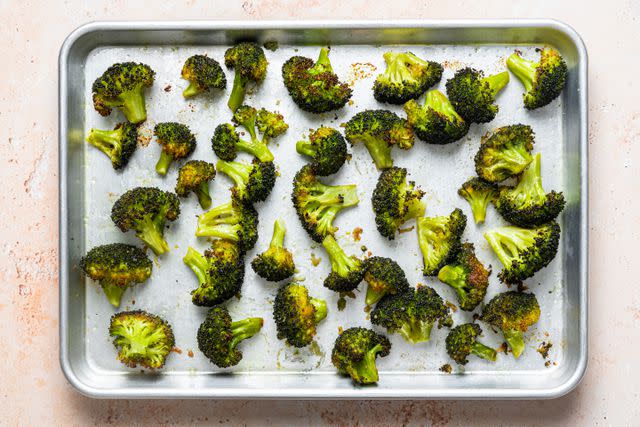
My favorite thing to make on a sheet pan is roasted vegetables for dinner or a week of meal prep. I like the way vegetables like carrots, parsnips, celery root, and beets take on a little char in a hot oven, amplifying their natural sweetness and making them fork-tender. Whether roasting root vegetables, broccoli florets, or halved Brussels sprouts, I have a trick for making sure every single bite is loaded with flavor: Before I pop that sheet pan in the oven, I toss the veggies with a vinaigrette.
The idea to use vinaigrette for roasting vegetables came from my farmer friend Autumn, and in my experience, any time a farmer tells you the best way to cook something, you should listen.
Over the summer, Autumn suggested that I try marinating summer squash in a vinaigrette before tossing them on the grill. The squash emerged from the grill bright and delicious. It was a revelation! This brilliant suggestion inspired me to give roasted vegetables the vinaigrette treatment, and the trick has yet to fail me.
Simply Recipes / Mihaela Kozaric Sebrek
How To Upgrade Roasted Veggies With a Vinaigrette
No matter what vinaigrette-veggie combo I choose, the method is the same: Toss the vegetables in a small amount of vinaigrette—about 1/4 cup at most per pound of vegetables—and let them hang out for five to 10 minutes to give them a chance to soak through. Then use your hands to scoop them onto a parchment-lined baking sheet and roast at 400°F until caramelized and tender, about 15 to 20 minutes, depending on the veggies.
What Kind of Vinaigrette To Use
The type of vinaigrette I use depends on the vegetables I'm roasting. Because we eat a lot of salads in my house, I usually have a few jars of homemade vinaigrette in the fridge. If not, I always have the ingredients to quickly whip one up. My favorite vinaigrette is a simple combination of chopped shallots, Dijon mustard, champagne vinegar, salt, pepper, and olive oil. I combine everything but the oil and then drizzle in the oil slowly while whisking to emulsify the dressing.
My standard vinaigrette works well for just about anything, especially sweet potatoes and parsnips, which are already a little on the sweeter side.
I’ll riff on my go-to vinaigrette depending on what I have on hand and what I’m planning to cook. Maybe I’ll substitute balsamic vinegar if I’m looking for something a little sweeter, or I’ll use whole-grain mustard if I want the pop of mustard seeds.
A whole-grain mustard vinaigrette is good on roasted carrots, while a balsamic version brightens up beets beautifully. It’s fun to play around and come up with different combinations because there are no wrong answers.
Simply Recipes / Adobe Stock
Tips for Marinating Roasted Veggies With a Vinaigrette
This is a pretty straightforward technique, so there’s not much that can go wrong, but there are a few things to keep in mind.
Don't Drown Your Veggies: You don't need a ton of dressing; rather, the opposite is true. Use about 1/4 cup for a pound of vegetables. You need just enough to add some flavor. Too much moisture and your veggies will steam rather than roast, which means they won't caramelize.
Store-Bought Is Fine: While I prefer to use a homemade vinaigrette, you could use a store-bought vinaigrette. Brands I like and recommend include Annie’s Balsamic Vinaigrette, Ken’s Steakhouse Greek Dressing, and Good Seasonings Italian Dressing. When using store-bought, check the ingredients for added sugars, which can burn in the oven. You can still use it, just keep an eye on the veggies as they roast.
Since at least August 2023, Facebook users have shared a warning about the purported dangers of McDonald's french fries containing "acrilane," which was described as "the most carcinogenic ingredient in cigarettes." That warning – which was shared both as copied-and-pasted text and in image form – also mentioned a pesticide that, when sprayed on potatoes grown for McDonald's, was supposedly so harmful that it required farmers to stay away for several days.
The most popular version of the rumor read as follows:
One large McDonald's french fry from McDonald's has the same amount of Acrilane as a pack of cigarettes. Acrilane is the most carcinogenic ingredient in cigarettes. McDonald's french fries are harvested from potatoes that are sprayed with a pesticide that is so harmful to humans that the farmers must let it sit for four days before they can safely handle it. Enjoy your fries!
We reached out to McDonald's via its media relations email address several times to ask about this matter but did not receive a response.
In our research, we found that the rumor was misleading in a number of different ways. This fact check explains why.
Acrylamide, Not 'Acrilane'
First off, as one Facebook user pointed out, "there is no such thing as 'acrilane.'" A Google search for the word "acrilane" with quotes around it mainly produced results for street names in the U.S.
The fact that whoever started this rumor misremembered and/or couldn't correctly spell the same of the purported "ingredient" did not bode well for the rest of our findings.
In our research, we found that the unknown user who originated this rumor was most likely referring not to "acrilane," but rather to acrylamide, as at least one user noted. Acrylamide forms as a byproduct of burning ingredients in cigarettes, but is not itself an “ingredient” in cigarettes. It is among many chemicals found in cigarette smoke classified as carcinogenic or potentially carcinogenic to humans.
Acrylamide Health Risks
Acrylamide is a substance that forms when an object, such as food or cigarettes, is heated up. For example, the longer that food is fried, roasted or baked, the higher the levels of acrylamide will be. As the FDA described on its website, the substance forms through a natural chemical reaction between sugars and asparagine, an amino acid, in plant-based foods – including potato and cereal-grain-based foods.
The FDA provided the following information about any associated health risks pertaining to acrylamide:
Acrylamide has been shown to cause cancer in animals exposed to very high doses, and although there is no consistent epidemiological evidence on the effect of acrylamide from food consumption on cancer in humans, both the U.S. National Toxicology Program and the Joint Food and Agriculture Organization/World Health Organization Expert Committee on Food Additives (JECFA) consider acrylamide to be a human health concern.
Acrylamide exposure can be detected by testing for the presence of acrylamide markers in the blood. According to scientists at the Centers for Disease Control and Prevention, markers of acrylamide exposure can be found in the blood of 99.9% of the U.S. population; however, finding these markers does not imply that their presence will result in adverse health effects.
As new research on the effect of acrylamide exposure becomes available, FDA experts will consider it in their continued evaluation of the risk that acrylamide may pose to human health.
Like the FDA, the European Union's European Food Safety Authority (EFSA) also published a page about acrylamide, notably saying that a 2015 risk assessment led experts to conclude that the substance "potentially increases the risk of developing cancer for consumers in all age groups," but that "studies on human subjects have provided limited and inconsistent evidence of increased risk of developing cancer."
Further, McDonald's restaurants in California are required by the state's Proposition 65 to display a sign that mentions the purported dangers of acrylamide, as users have noted with popularvideos.
Acrylamide Levels in Fries and Cigarettes
The Facebook rumor apparently intended to compare the amount of acrylamide in one large order of McDonald's french fries against the amount contained in an entire pack of cigarettes. We found past studies that attempted to measure acrylamide levels from the FDA, Annals of Agricultural and Environmental Medicine and Environmental Research.
The FDA's data from 2011 documented acrylamide levels in not just McDonald's french fries, but also similar levels of the substance in french fries from Burger King, Checkers, Chick-fil-A, KFC, Sonic, Wendy's and other restaurants. In other words, McDonald's was not a unique case in this regard. Rather, McDonald's was singled out by whoever started the viral rumor about acrylamide, when that person just as easily could have chosen to name any other restaurant.
Frequency of Consumption
To learn more about this subject, we consulted with Lindsey Wohlford, a wellness dietitian at The University of Texas MD Anderson Cancer Center. Wohlford told us during a Zoom call that it's "hard to compare" acrylamide levels in french fries and cigarettes, for a variety of different reasons.
"Generally, somebody who's going to be smoking is going to be doing that multiple times throughout the day, whereas somebody who is eating McDonald's french fries might be exposed to it once, perhaps twice," Wohlford said. "But, it's not something that's probably consumed as regularly as somebody who's smoking cigarettes."
A McDonald's Big Mac and french fries are seen on a tray on April 30, 2018 in Miami, Florida. (Photo by Joe Raedle/Getty Images)
Variability
One aspect of measuring acrylamide levels that should be noted is the fact that there are differences in the makeup of food products and in the times and methods of their preparation. For any researchers attempting to measure levels of the substance, these factors will provide varying results.
"Acrylamides in food products are very hard to measure because it depends on the innate amount of starch in an individual food at the time of cooking. There's variability," Wohlford said.
"Every single apple in the world doesn't have the 100% exact makeup. There's going to be some variability just depending on growing conditions, exposure to light and exposure to water. Nutrients in the soil. So, there's innately some differences in the nutritive content and makeup of foods. The other things, the other variable, is the cooking process. The method, the cooking time, the temperature and all of those things can impact the amount of acrylamide formed."
Entering the Bloodstream Differently
There's also the fact acrylamide enters the bloodstream in one way with food and in another way with cigarette smoke, as Wohlford told us.
"It's my understanding and knowledge that really there's quite a bit more [acrymalides] generally found when we do bloodwork with those people who smoke," she continued. "They tend to contain more acrylamides than people who are eating french fries, or McDonald's french fries."
"I think it's been fairly well-established that there are acrylamides that are from cigarette smoke. And that, in conjunction with obviously other aspects from smoking, are a risk for cancer. What we know with acrylamides from food, which are ingested in different ways, the cigarette smoke that's inhaled is going to go through the lungs and into the bloodstream, whereas food is going to be digested and potentially absorbed through our GI tract into the bloodstream."
Cancer Risk for Humans
Regarding the possible risk of cancer with the substance, Wohlford told us, "The vast majority of studies have been done on rodents, and they've been done in very large amounts, thousands of times what the average human is going to absorb from a food. And so, we really don't know the exact concerns we should have, or lack thereof, with acrylamides, as far as cancer risk, from any source — McDonald's french fries or any other source of acrylamides."
The FDA also published much the same, saying that, "Although it's not clear exactly what risk acrylamide poses to humans, the FDA has recommendations for both consumers and industry about how to reduce acrylamide formation in foods."
'Not Apples to Apples'
"On the internet, people take a grain of truth or a small piece of science out of context and they want to apply it to multiple situations or across the board," Wohlford said. "You can't really look at science in that way. It doesn't translate exactly that way. You have got to look at the circumstances surrounding the studies and the methods that were used.
"If they're not comparing apples to apples, you can't make any kind of a bottom line assumption."
Marianna Naum, an acting director with the FDA's Center for Food Safety and Applied Nutrition, who said she holds a doctoral degree, also told us in a separate call that the rumor circulating on Facebook was "not an accurate comparison," adding that with french fries and cigarettes, "there are different absorption pathways of how they would enter the body when something is ingested as opposed to when inhaled," a fact that Wohlford also previously noted.
The Big Picture
In our call with Wohlford, she told us that there's something missing from the Facebook rumor:
I think the bigger point here is that there are a lot of reasons to not eat french fries that are probably going to put you at bigger risk for chronic disease and health concerns more than acrylamides at this point. You're more likely to die of heart disease and other inflammatory conditions from eating french fries frequently than you are from exposure to cancer. So, we want to avoid french fries? Could it be because of the acrylamides contained in them? It could be. We really don't have the science to say that definitively yet. But we do have the science to say, hey, avoid this stuff because of other risks.
Also, weight gain. When people gain weight, overweight and obesity are associated with 13 different kinds of cancer. We know that french fries and many other highly processed, carbohydrate-rich foods, that also have acrylamides, are calorie-dense and can lead to increased weight gain, which puts people at risk for developing cancer.
Near the end of our call, Wohlford added, "To me, I think it's so interesting that people are even that concerned about this. I'm not saying they shouldn't be concerned, but to just be focused on this one component of McDonald's french fries, I think, if you're concerned about your health, why are you eating french fries at all? It's not so much this one component that may be in french fries in large amounts that we need to focus on."
Much of what Wohlford said was spelled out in a March 2022 article published on the MD Anderson Cancer Center website titled, "5 facts about acrylamide and cancer risk."
Pesticide Requires Farmers to Wait 4 Days?
The second half of the viral warning claimed that potatoes used by McDonald's are sprayed with a pesticide that's so harmful that farmers wait four days before handling them.
However, the truth was that the U.S. Environmental Protection Agency (EPA) includes in the compliance requirements for its Agricultural Worker Protection Standard (WPS) that, after pesticides have been applied to crops, a restricted-entry interval (REI) must be followed to keep workers safe. In other words, any such waiting period was not an unusual standard to have imposed when pesticides are used.
Additional Notes
According to The Associated Press, the first substantial data published about acrylamide content in potatoes, cereal products and coffee came from scientists with the Swedish National Food Agency in the spring of 2002. At the time, the reporting cited new data from the FDA, saying in part that "the longer french fries and certain other starchy foods are fried or baked, the higher their level of a possible cancer-causing substance, new federal research suggests."
For further reading, Full Fact, Lead Stories and McGill's Office for Science and Society previously published reporting that provided the facts about a similar rumor that claimed McDonald's makes french fries from potatoes that were treated with a pesticide known as Monitor (methamidophos). Also, in 2021, the National Library of Medicine published new research about acrylamide and french fries, which included mentions of past guidance relevant to the substance brought forth by the state of California and the European Union.
We also looked into another substance, acrolein, for the purposes of this story. As an article from the National Library of Medicine noted, like acrylamide, acrolein is also present in cooked foods, including those fried in oil. Acrolein is a carcinogen and is present in the smoke of cigarettes. Due to the amount of past data regarding McDonald's french fries and acrylamide, most of which is spelled out in this article (including Prop 65 signs at McDonald's locations in California that mentioned acrylamide by name), it appeared that the person who created the viral rumor most likely was referencing past data about acrylamide, not acrolein.
Sources
“About Proposition 65.” California Office of Environmental Health Hazard Assessment, https://ift.tt/ly1UnCm.
“Acrylamide.” EFSA, https://ift.tt/lu5xfc9.
“---.” California Office of Environmental Health Hazard Assessment, https://ift.tt/hrs4fwD.
“Acrylamide and Cancer Risk.” American Cancer Society, https://ift.tt/T04GZzA.
Alexander, Heather. “5 Facts about Acrylamide and Cancer Risk.” MD Anderson Cancer Center, 4 Mar. 2022, https://ift.tt/mEq7fCh.
“Cancer.” How Tobacco Smoke Causes Disease: The Biology and Behavioral Basis for Smoking-Attributable Disease: A Report of the Surgeon General, Centers for Disease Control and Prevention (US), 2010, https://ift.tt/54DflJc.
Center for Food Safety and Applied Nutrition. “Acrylamide.” FDA, https://ift.tt/vmiG6VZ.
---. “Acrylamide Questions and Answers.” FDA, https://ift.tt/DVXizSJ.
---. “Guidance for Industry: Acrylamide in Foods.” FDA, 22 Sept. 2022, https://ift.tt/J4j8isp.
---. “Survey Data on Acrylamide in Food.” FDA, https://ift.tt/Y50sIPd.
Esposito, Francesco, et al. “Acrylamide Levels in Smoke from Conventional Cigarettes and Heated Tobacco Products and Exposure Assessment in Habitual Smokers.” Environmental Research, vol. 208, May 2022, p. 112659. ScienceDirect, https://ift.tt/S61CnO8.
Lee, Marlo. “Fact Check: McDonald’s Fries Do NOT Contain An Insecticide Named Monitor.” Lead Stories, 11 Nov. 2022, https://ift.tt/zyQRu3e.
Mojska, Hanna, et al. “Acrylamide Content in Cigarette Mainstream Smoke and Estimation of Exposure to Acrylamide from Tobacco Smoke in Poland.” Annals of Agricultural and Environmental Medicine, vol. 23, no. 3, July 2016, pp. 456–61, https://ift.tt/FXsBo4C.
Neergaard, Lauran. “FDA Releases Results of Starchy Food Studies.” The Sentinel via Newspapers.com, 5 Dec. 2022, p. A9, https://ift.tt/ftVxAke.
OCSPP US EPA. Agricultural Worker Protection Standard (WPS). 18 Sept. 2014, https://ift.tt/nPveLZc.
rgatoNacho. “McDonald’s Forced to Display Cancer Warnings in LA Stores.” r/TikTokCringe via Reddit.com, 9 Dec. 2022, https://ift.tt/C9TqGdA.
“Should We Fear McDonalds French Fries?” Office for Science and Society, McGill, 20 Mar. 2017, https://ift.tt/oKsASUM.
“Should You Be Concerned About Acrylamide in Coffee?” Healthline, 30 June 2020, https://ift.tt/GMky9YE.
Skinner, Mark M., et al. “Instrumentation for Routine Analysis of Acrylamide in French Fries: Assessing Limitations for Adoption.” Foods, vol. 10, no. 9, Aug. 2021, p. 2038. PubMed Central, https://ift.tt/yRxslJO.
Townend, Evie. “McDonald’s French Fries Are Not Made from Potatoes Treated with the Pesticide Monitor.” Full Fact, 17 May 2023, https://ift.tt/lGvKs8Y.
West, Phil. “‘Have You Ever Seen the WARNING SIGN at McDonald’s?’: McDonald’s Customer Shows ‘Warning Sign’ Plastered on Door before Entering.” The Daily Dot, 26 Oct. 2023, https://ift.tt/DGLucHU.
It will give your favorite roasted veggies a glow-up.
Simply Recipes / Adobe Stock
There’s one tool in my kitchen that gets used almost daily: my sheet pan. Lined with parchment paper and loaded with delicious ingredients, it consistently delivers meal after satisfying meal.
My favorite thing to make on a sheet pan is roasted vegetables for dinner or a week of meal prep. I like the way vegetables like carrots, parsnips, celery root, and beets take on a little char in a hot oven, amplifying their natural sweetness and making them fork-tender. Whether roasting root vegetables, broccoli florets, or halved Brussels sprouts, I have a trick for making sure every single bite is loaded with flavor: Before I pop that sheet pan in the oven, I toss the veggies with a vinaigrette.
The idea to use vinaigrette for roasting vegetables came from my farmer friend Autumn, and in my experience, any time a farmer tells you the best way to cook something, you should listen.
Over the summer, Autumn suggested that I try marinating summer squash in a vinaigrette before tossing them on the grill. The squash emerged from the grill bright and delicious. It was a revelation! This brilliant suggestion inspired me to give roasted vegetables the vinaigrette treatment, and the trick has yet to fail me.
Simply Recipes / Mihaela Kozaric Sebrek
How To Upgrade Roasted Veggies With a Vinaigrette
No matter what vinaigrette-veggie combo I choose, the method is the same: Toss the vegetables in a small amount of vinaigrette—about 1/4 cup at most per pound of vegetables—and let them hang out for five to 10 minutes to give them a chance to soak through. Then use your hands to scoop them onto a parchment-lined baking sheet and roast at 400°F until caramelized and tender, about 15 to 20 minutes, depending on the veggies.
What Kind of Vinaigrette To Use
The type of vinaigrette I use depends on the vegetables I'm roasting. Because we eat a lot of salads in my house, I usually have a few jars of homemade vinaigrette in the fridge. If not, I always have the ingredients to quickly whip one up. My favorite vinaigrette is a simple combination of chopped shallots, Dijon mustard, champagne vinegar, salt, pepper, and olive oil. I combine everything but the oil and then drizzle in the oil slowly while whisking to emulsify the dressing.
My standard vinaigrette works well for just about anything, especially sweet potatoes and parsnips, which are already a little on the sweeter side.
I’ll riff on my go-to vinaigrette depending on what I have on hand and what I’m planning to cook. Maybe I’ll substitute balsamic vinegar if I’m looking for something a little sweeter, or I’ll use whole-grain mustard if I want the pop of mustard seeds.
A whole-grain mustard vinaigrette is good on roasted carrots, while a balsamic version brightens up beets beautifully. It’s fun to play around and come up with different combinations because there are no wrong answers.
Simply Recipes / Adobe Stock
Tips for Marinating Roasted Veggies With a Vinaigrette
This is a pretty straightforward technique, so there’s not much that can go wrong, but there are a few things to keep in mind.
Don't Drown Your Veggies: You don't need a ton of dressing; rather, the opposite is true. Use about 1/4 cup for a pound of vegetables. You need just enough to add some flavor. Too much moisture and your veggies will steam rather than roast, which means they won't caramelize.
Store-Bought Is Fine: While I prefer to use a homemade vinaigrette, you could use a store-bought vinaigrette. Brands I like and recommend include Annie’s Balsamic Vinaigrette, Ken’s Steakhouse Greek Dressing, and Good Seasonings Italian Dressing. When using store-bought, check the ingredients for added sugars, which can burn in the oven. You can still use it, just keep an eye on the veggies as they roast.
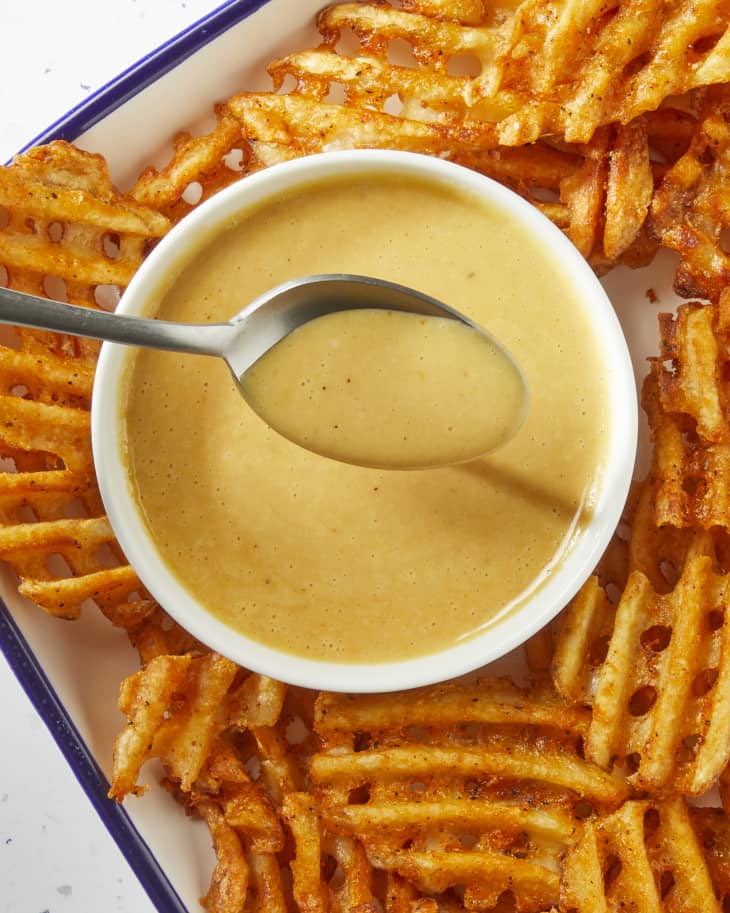
Smoky, tangy, rich — there’s a lot to love about Chick-Fil-A sauce. This flavorful dipping sauce came on the scene and I’ve been in love ever since. My favorite part about it: It’s easy to replicate at home with condiments I always have on hand.
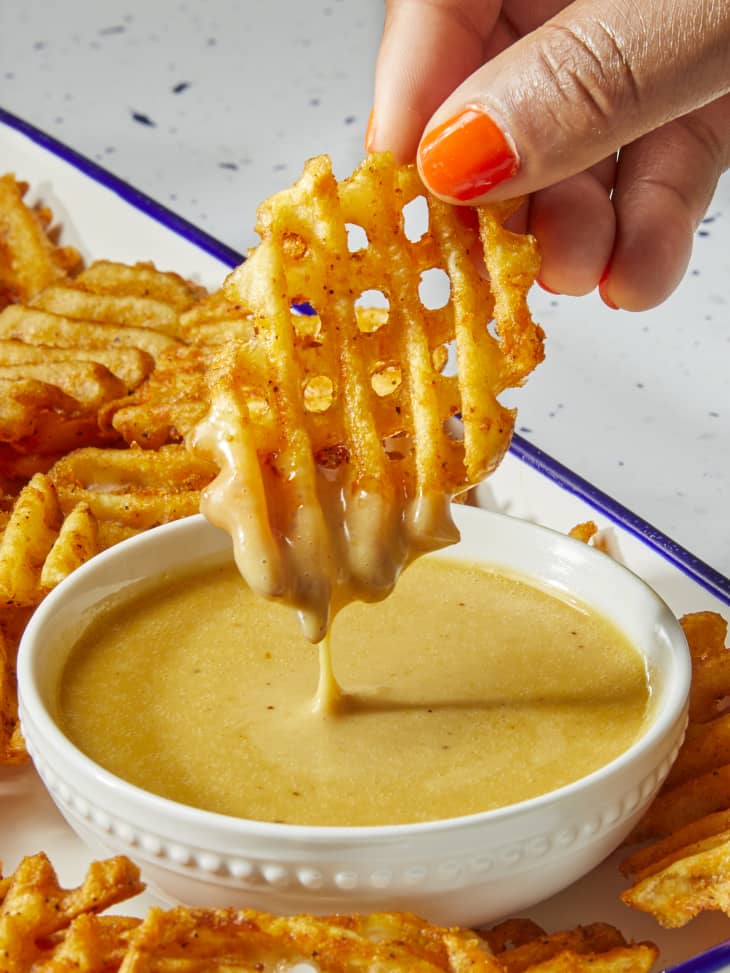
Sometimes copycat recipes don’t quite hit the mark, but this one passes the test (and by test, I mean the blind taste test performed by my partner and me). This homemade version was indistinguishable from the original. And much like the original, this dipping sauce is the perfect complement to crispy fries — especially the waffle variety — and chicken nuggets.
The History of Chick-Fil-A Sauce
In Fredericksburg, Virginia, in the early 1980s, franchise operator Hugh Fleming started making honey mustard to serve alongside their chicken nuggets because Chick-Fil-A didn’t have any sauces at the time. Then one day, an employee accidentally mixed some barbecue sauce into the honey mustard. From there, the sauce became wildly popular in the area and remained a local specialty for years.
Before retiring in 2007, Fleming gave Chick-Fil-A the recipe and they started distributing the sauce in their signature containers in restaurants nationwide the following year. Today, it’s the company’s most popular sauce.
The sauce sold in stores is a combination of their honey mustard, barbecue, and ranch sauces, but you can recreate it to perfection with just five ingredients.
Barbecue sauce. Classic tomato-based barbecue sauce gives it that signature smokiness.
Yellow mustard. Adds a savory bite and the signature golden color.
Honey. The sweetness balances out the mustard.
Mayonnaise. Adds richness and tang.
Lemon. A splash of fresh lemon juice adds brightness to the store-bought condiments.
What to Eat with Chick-Fil-A Sauce
Chick-Fil-A Sauce Recipe
Mix smoky barbecue sauce, sweet honey, and tangy mustard together to make the most satisfying dipping sauce.
Prep time 5 minutes
Makes3/4 cup
Serves4 to 6
Nutritional Info
Ingredients
1/2
medium lemon
1/2cup
mayonnaise
2tablespoons
plus 1 teaspoon honey
2tablespoons
tomato-based barbecue sauce, such as Sweet Baby Ray’s
1tablespoon
prepared yellow mustard
Instructions
Juice 1/2 medium lemon until you have 1 teaspoon. Place in a small bowl. Add 1/2 cup mayonnaise, 2 tablespoons plus 1 teaspoon honey, 2 tablespoons tomato-based barbecue sauce, and 1 tablespoon prepared yellow mustard. Stir until smooth. Serve at room temperature, or cover and refrigerate for 1 hour if you want to serve it chilled.
Recipe Notes
Make ahead: The sauce can be made up to 3 days ahead. Refrigerate in an airtight container.
Storage: Leftovers can be refrigerated in an airtight container for up to 5 days.
Adding chile to your pecan pie recipe may seem a bit odd if you're used to making it the classic way, but there's a good reason Ree Drummond adds it to the filling, mainly that it balances out the other ingredients. Similar to using salt in desserts, chile peppers have the ability to counteract the sweetness of the sugar so it's not so overwhelming. Unlike salt however, chile also adds smoky, warm flavors, rather than just saltiness. The added complexity ultimately makes the filling taste more satisfying.
Technically ancho chile and cayenne pepper by themselves can upgrade the flavor of a pecan pie, but Ree Drummond takes it a step further by incorporating a hint of cocoa powder too. Chocolate and chile is a powerful combination, because it causes different flavors to get activated. Therefore, when you add both to your pecan pie, it will also bring out the herbaceous, fruity notes in them.
Desserts don't always have to be 100% sweet. In cheesecake for example, it isn't uncommon to add lemon juice to give it some tang. Many desserts that call for caramel also include salt for a sweet and savory final product. And even bitter flavors in the form of espresso powder or rum can make for a tasty dessert. Spiciness on the other hand is a far less popular flavor profile. Other than the ones that appear in pumpkin and apple pie spice such as cinnamon, cloves, and nutmeg, spices are usually left out of the majority of desserts.
Ree Drummond however doesn't shy away from heat when making pecan pie. The celebrity chef, who also goes by The Pioneer Woman, strays from tradition in that her pecan filling isn't just flavored with vanilla extract and sugar. It also includes ancho chile powder as well as cayenne pepper.
If you typically shy away from fiery foods, don't despair. You won't be able to detect any heat from the two spices. Instead, you'll just be able to taste the flavor enhancing effects of them.
Slice cut from pecan pie topped with whipped cream - Elena Veselova/Shutterstock
Adding chile to your pecan pie recipe may seem a bit odd if you're used to making it the classic way, but there's a good reason Ree Drummond adds it to the filling, mainly that it balances out the other ingredients. Similar to using salt in desserts, chile peppers have the ability to counteract the sweetness of the sugar so it's not so overwhelming. Unlike salt however, chile also adds smoky, warm flavors, rather than just saltiness. The added complexity ultimately makes the filling taste more satisfying.
Technically ancho chile and cayenne pepper by themselves can upgrade the flavor of a pecan pie, but Ree Drummond takes it a step further by incorporating a hint of cocoa powder too. Chocolate and chile is a powerful combination, because it causes different flavors to get activated. Therefore, when you add both to your pecan pie, it will also bring out the herbaceous, fruity notes in them.
How Much Chile You Should Add To Pecan Pie
pouring pecan pie filling into pie shell - Sarahdoow/Getty Images
Adding chile powder to pecan pie isn't quite like adding vanilla extract — you'll need a lot more of it in order to taste a difference. For reference, Ree Drummond's pecan pie calls for just one teaspoon of vanilla extract, but a little over one tablespoon of ancho chile powder in addition to half a teaspoon of cayenne pepper. This may seem like a lot especially in comparison to the vanilla, but it only serves to elevate the flavor.
However if you're hoping for a more subtle effect, consider taking the approach of fellow TV personality Joanna Gaines. The pecan pie recipe she shared in the "Magnolia Table" cookbook also calls for heat, but much less compared to Drummond's, only about two teaspoons. And instead of using both cayenne pepper and ancho chile powder, Gaines only opts for ancho chile powder. She also pairs it with cinnamon rather than cocoa powder, a spice combination that introduces extra warmth, but not nearly as much complexity. It still results in a delicious pecan pie, so clearly even a small amount of it is worth adding to the dessert.



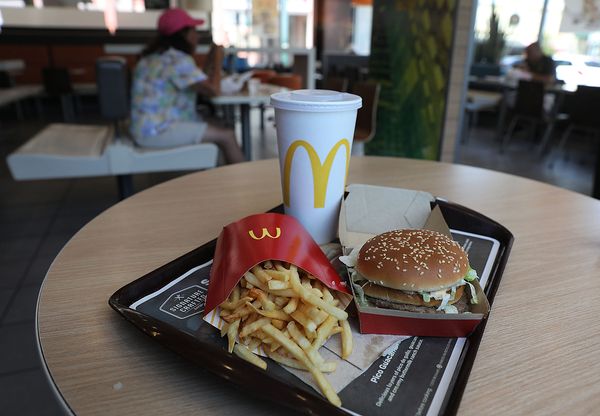 A McDonald's Big Mac and french fries are seen on a tray on April 30, 2018 in Miami, Florida. (Photo by Joe Raedle/Getty Images)