Sunday, October 23, 2022

I made butter from scratch with one ingredient amid rising costs and a looming shortage. It took 20 minutes and practically zero effort. - Yahoo News

-
A supply shortage has caused the price of butter to skyrocket ahead of the holidays.
-
The only ingredient needed to make homemade butter is heavy cream.
-
Use salt and other add-ins to give your butter different flavors.
A supply shortage caused the price of butter to surge ahead of the holidays.
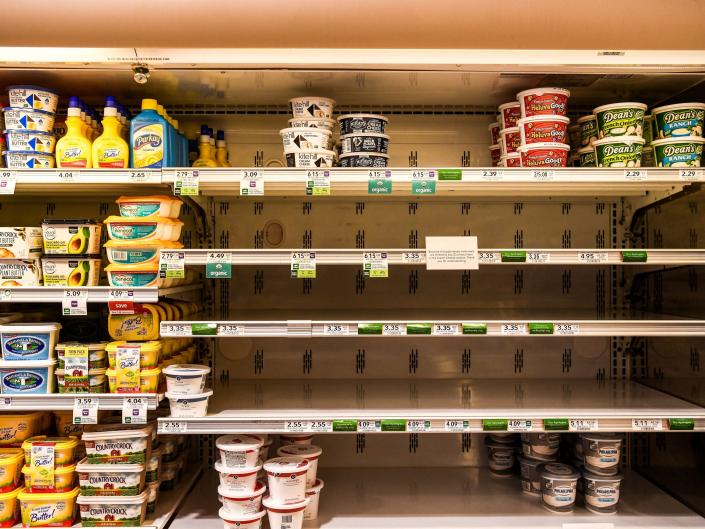
Between sweet potato pie and cookies baked for Santa Claus, butter might be the unsung hero of the winter holiday season. But according to the Wall Street Journal, there'll be less butter to go around this year.
The outlet reported lower milk production on US dairy farms, and ongoing labor shortages at processing plants have resulted in the lowest amount of butter in US cold storage facilities since 2017.
The decline prompted the cost of butter at US supermarkets to surpass most other foods in the past year, with the price of butter rising 24.6% between August 2021 and August 2022, the WSJ reports. According to CNBC which cited data from the US Bureau of Labor Statistics, the cost of butter rose 27%, and margarine surged 44% from September 2021 to September 2022.
Since I'm trying to save money amid the nationwide inflation, I decided to try my hand at making homemade butter. I used a recipe by popular TikToker itz_zealand as a reference.
You'll only need one ingredient to make homemade butter.
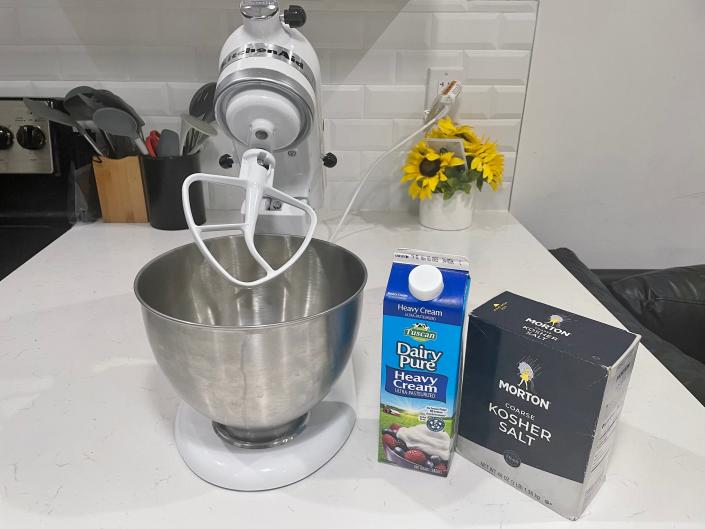
Fortunately, making butter is a fairly cheap endeavor since it only requires one ingredient: heavy cream. Adding salt or other flavorings is an option, but not necessary.
You'll also need the following:
-
A stand mixer
-
One large bowl
-
A strainer
To start, pour the heavy cream into a stand mixer with the whisk or flat beater attachment.

I used a one-quart carton – or four cups – for my butter, but feel free to use as much or little as you want.
I whisked the heavy cream for 20 minutes, starting at a low setting before gradually increasing to a medium speed.

For the first 10 minutes, the heavy cream retained its liquid form and showed no signs of firming up. I started whisking on the lowest setting of my KitchenAid stand mixer.
After 10 minutes, the heavy cream began to thicken and cling to the flat beater attachment.
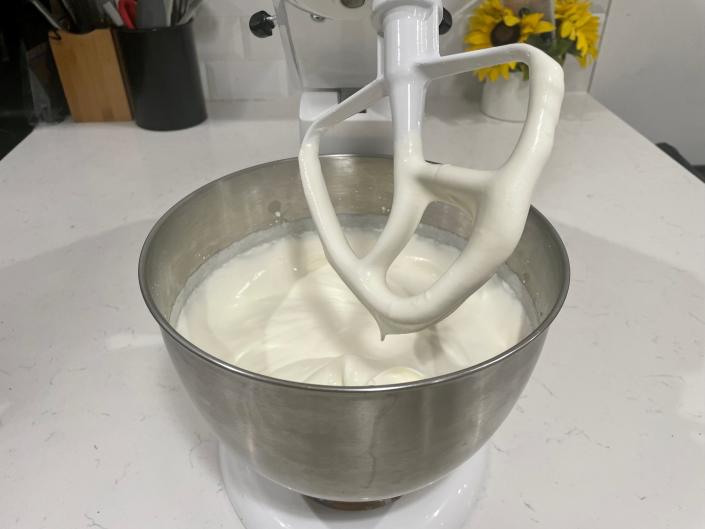
10 minutes into whisking the heavy cream, it slowly began to thicken, resembling a very light yogurt in look and texture. I found it helpful to occasionally stop the stand mixer and scrape excess heavy cream stuck to the sides back into the fold.
A few more minutes of whipping allowed the solid butter to separate from the buttermilk.
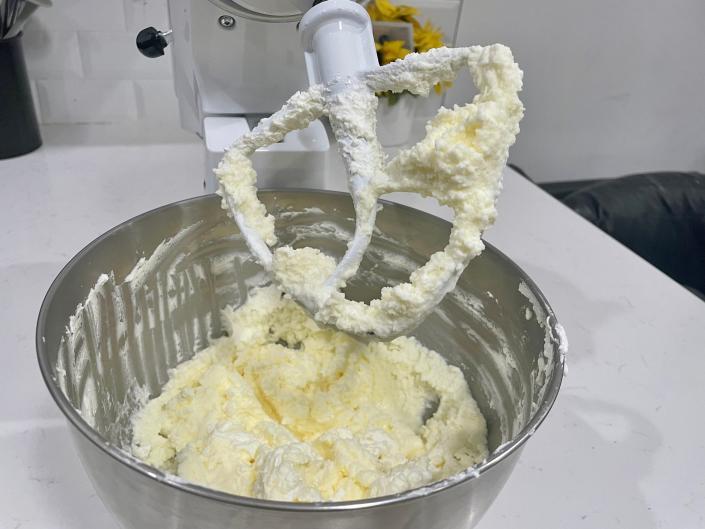
Around 20 minutes into whisking, pieces of solid butter began to form and separate from the buttermilk. When this happens, the butter-making process is almost done.
Stop the stand mixer once the solid butter consolidates.

By now, there should be a noticeable pool of buttermilk at the bottom of your stand mixer. It's your choice whether or not you want to keep the buttermilk, but Bon Appétit reported that there are tons of uses for it.
At this point, the solid butter should feel firm but pliable and take on a light yellow color.
Use a strainer to separate the solid butter from the buttermilk.
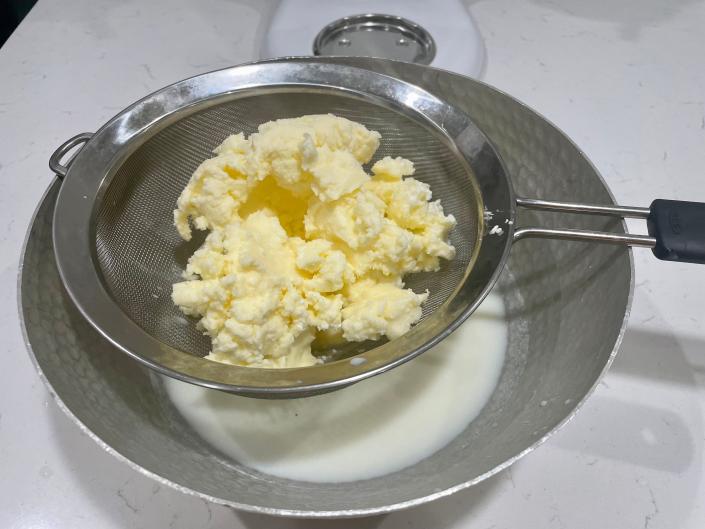
Place the strainer over a large bowl and separate the butter from the buttermilk.
Rinse the butter with ice water to remove excess buttermilk.

Transfer the solid butter to another large bowl and add cold water to help rid it of excess buttermilk. Master Class suggested using a flexible spatula to do the task, but I used my hands.
Repeat this process until the ice water goes from murky to clear.
You've officially made homemade butter! Use add-ins like salt and garlic to give the butter an extra burst of flavor.

The final steps are to add any extra flavors to the butter and store it away. Personally, I added ¾ tablespoon of salt to give it a slight flavor since it tasted very neutral at first.
I wasn't sure what to expect with this recipe, but I haven't stopped telling everyone I know about it because it's that good. The texture, when at room temperature, is creamy and the taste is light and airy.
It might be in my head, but when I compared my homemade butter to a store-bought version, the homemade butter tasted less processed.
Also, "homemade butter" always made me think of a wooden butter churn and lots of arm work, but the recipe was hands-off and only took 20 minutes.
Overall, I would 1000% make this recipe again, and I have plans to add chives, garlic, and parsley next time.
Read the original article on Insider
I made butter from scratch with one ingredient amid rising costs and a looming shortage. It took 20 minutes and practically zero effort. - Yahoo News
Read More
Yes, The Order You Put Ingredients Into A Blender Matters - Tasting Table
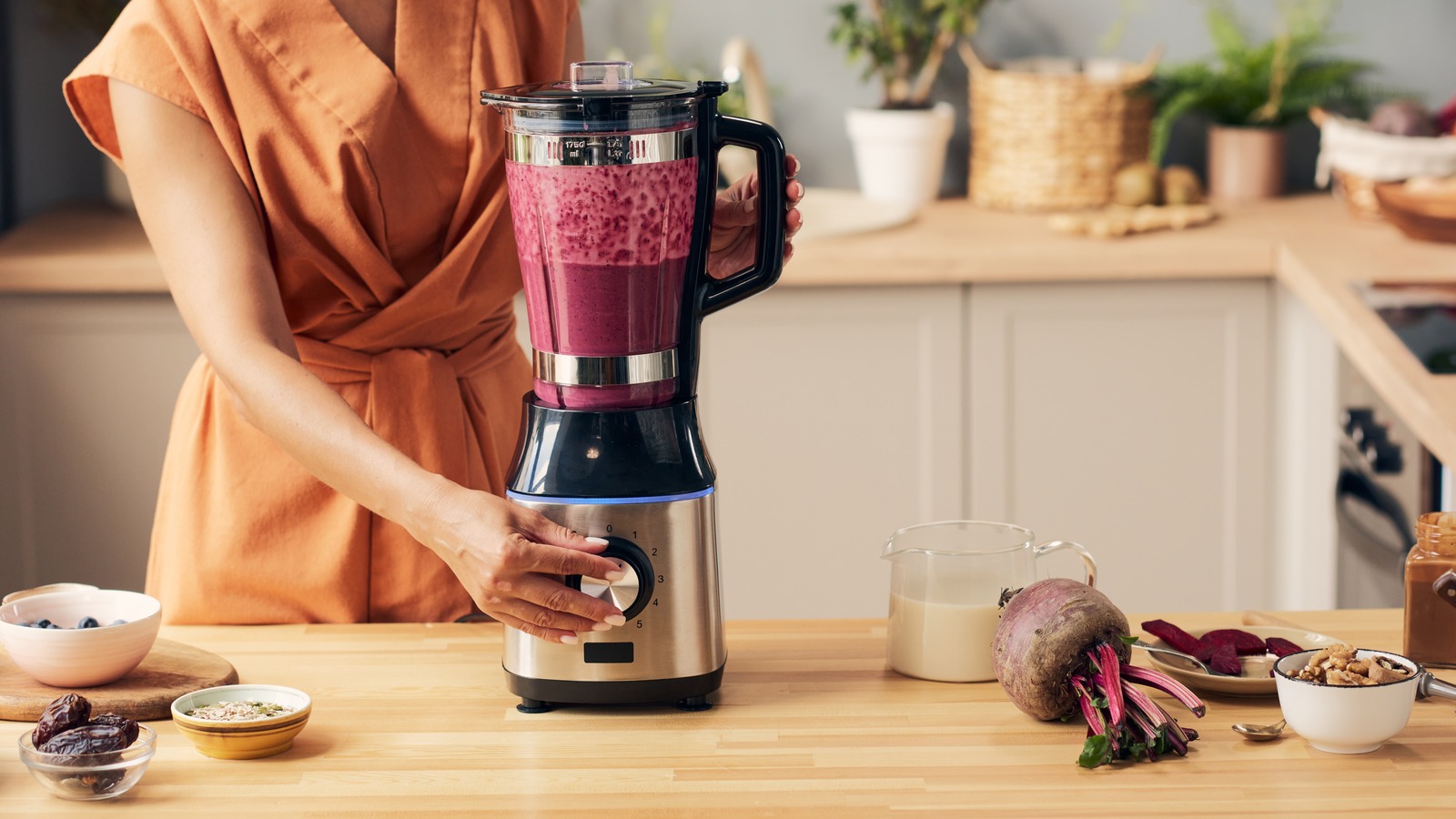
Many of us often start by throwing in the base ingredient of our smoothie first. Whether that's frozen fruit or fresh greens. However, according to Kitchn, this shouldn't be the first step. The site says to pour in your liquids first. Whether that's water, juice, or your choice of milk, this essential first step allows for adequate blending, and it will easily pull in the main ingredients that are later added on top, creating a satisfying "vortex."
If you're a fan of powdered protein or powdered sweeteners like cacao you should make sure this is the second ingredient you add. Well + Good notes that "this helps to ensure that the powder is fully incorporated into your finished product, rather than clumped in odd, chalky ways." After this, fruits and veggies can be added. It is ideal if the softer ones go in first, but it is not as essential. If the harder ones can be tossed in after, they can push down the softer fruits, allowing them to incorporate better, according to Well + Good.
Kitchn says the second to last step is to add any fruits, seeds, or nuts you want to your smoothie. Then, it's time to top off with the ice, and blend! We hope these tips make your breakfast routine easier ending your frustrated blender-shaking mornings.
Yes, The Order You Put Ingredients Into A Blender Matters - Tasting Table
Read More
Saturday, October 22, 2022
The Key Ingredient That Gives Rye Bread Its Unique Flavor - Tasting Table
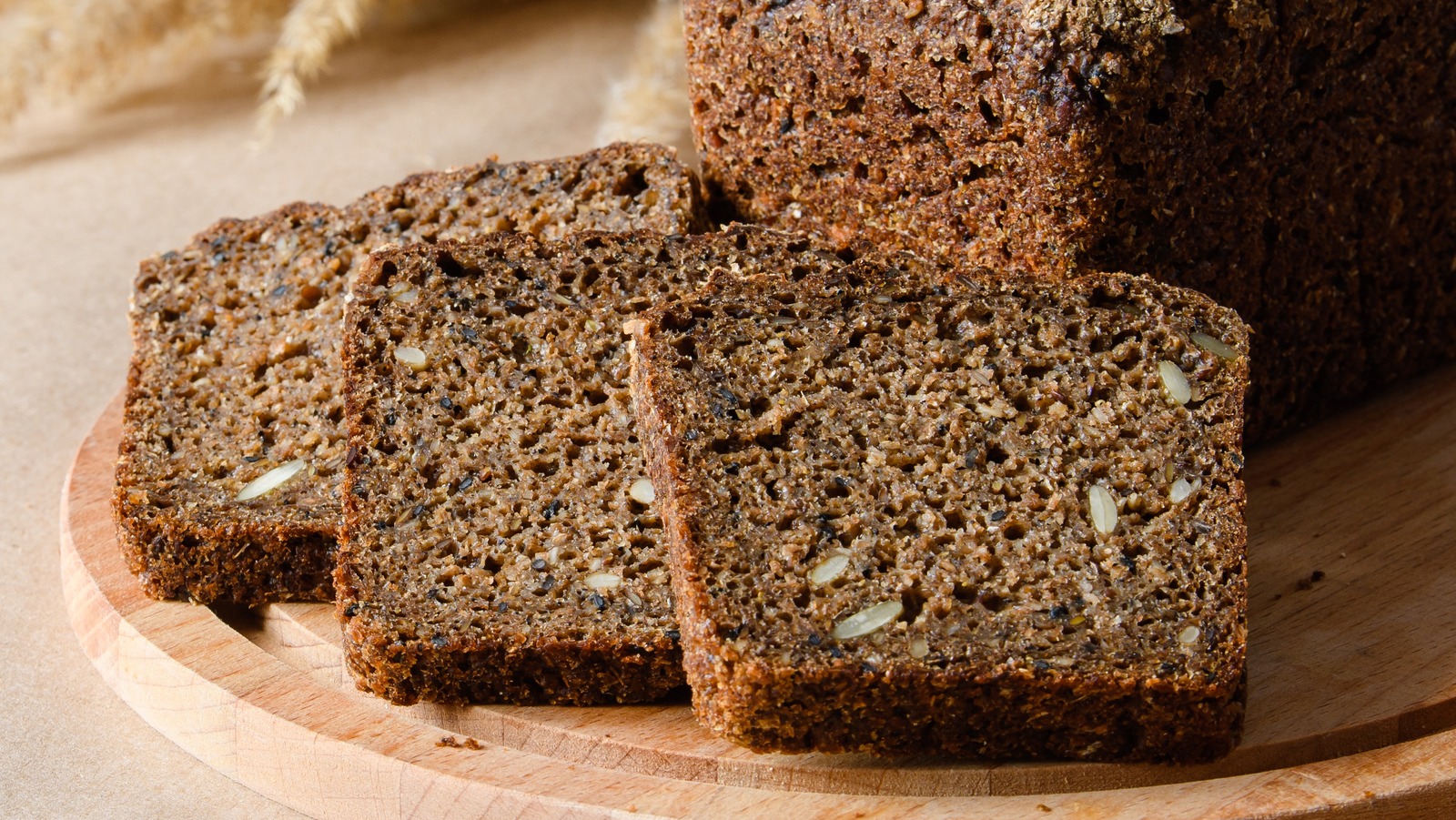
We're talking, of course, about caraway seeds. These aromatic little seeds that are a member of the parsley family with a sweet yet tangy flavor (via Spice Advice). They are responsible for the "vibrant, earthy flavor a little like a strong herbal tea," in rye bread, per Thrive Cuisine. Caraway is a very common ingredient in commercially baked rye bread, so much so that it's been misconstrued for the flavor of the actual rye grain, per Zingerman's Bakehouse.
Rye has a flavor profile uniquely its own. Far from the citrusy tang of caraway seeds, King Arthur Baking invites us to think of rye as a combination of earth, malt, and nuts, kind of like an old-fashioned milkshake. In addition to its unique flavor, rye has a chewy texture because of its naturally low gluten content and high moisture retention.
In order to really get an idea of rye's depth of flavor, you need to try a slice of pumpernickel. Pumpernickel is a bread notorious for how long it takes to make, but the result is a deep, darkly rich rye-based bread with an amalgamation of sweet and sour flavors (via German Food Guide). While it's heavier than many other types of rye bread, including rye sourdough, pumpernickel will still give you the most rye for your buck.
The Key Ingredient That Gives Rye Bread Its Unique Flavor - Tasting Table
Read More
Sustainability is a key missing ingredient in White House hunger plan - The Hill

We recently joined President Joe Biden and thought leaders from throughout the nation at the White House Conference on Hunger, Nutrition and Health. As experts in nutrition education and behavior, we were impressed by the administration’s understanding of this complex topic — but there was a critical element missing.
Both the conference and the accompanying strategy released by the White House said very little about building food systems that are sustainable. That is disappointing because shifting our nation’s food supply to more sustainable systems is necessary for meeting our national goals — not just in nutrition and health, but in battling climate change.
We urge the Biden administration to do more to incorporate sustainability into its food and agriculture plans going forward.
Sustainable food systems reduce the drain on the economy, society and ecology of the community they serve. The farmers in these systems are usually more local, more family owned and operated, more focused on the dietary needs of the community and more focused on providing living wages for local workers. They release less pollution and they can mitigate instead of add to climate change. They are profitable, viable businesses and globally produce most of the food that nourishes people. As many folks have learned in the past few years, these systems are often more resilient than the industrialized food system with its thinly stretched global supply chains.
Most of us think of these kinds of growers as showing up only in farmers markets or specialty grocery stores — not as playing a major role in our basic food supply. That’s starting to change, but we need to do much more.
First, let’s focus on how sustainable food systems help the Biden administration tackle hunger. Pillars 2 and 3 of the administration’s strategy talk about prioritizing the role of nutrition in health and empowering consumers to have access to healthy food choices. Both of these are a smart shift away from antiquated views on hunger, which focused only on quantity of food and not quality. The lack of healthy food options and the glut of ultra-processed food in many poor communities are well-known contributors to higher rates of diet-related conditions, such as such as diabetes and heart disease, in these neighborhoods.
That means making fresh fruits and vegetables more accessible and affordable in more communities, which can’t happen without more local growers bringing these perishable foods to market. In 2019, the U.S. Department of Agriculture awarded about $72 million in grants to support specialty crops, which includes fruits and vegetables as well as nuts and flowers. That same year, through various programs, the department handed out more than $4.2 billion in subsidies for corn, wheat and soy, according to the Environmental Working Group, a nonprofit group.
This is why it’s cheaper to buy nacho-flavored chips than broccoli. Ultra-processed foods being cheaper than fresh foods isn’t a market inevitably (it makes little sense when you think about the added costs of processing): It’s the result of government policy choices. We can choose to support more local, sustainable growers of fruits and vegetables instead.
That’s why growing sustainability and fighting hunger aren’t opposed, as some have claimed, but are linked. Those who have blocked efforts to prioritize sustainability have often claimed they are standing up for communities dealing with hunger. But in our experience, these communities understand, value and want the choices offered by resilient, locally based food systems.
The real source of the opposition are the corporations that dominate our food system and are seeing increased profits as food prices rise. Because of industry consolidation in the past few decades, market power in our food system is dominated by a handful of meat- and poultry-processing companies and a few multinational companies that produce most products on supermarket shelves. The current system works for them, and they are using the language of hunger to defend their profits.
Just as importantly, the current globalized food system is deeply dangerous to our global health. Both of us are members of the Society for Nutrition Education and Behavior and, as that organization said in its official comments on the White House conference, “the food system both significantly impacts and is significantly impacted by climate change and ecosystem fragility.” This year we are already seeing the devastation that climate change-fueled storms, floods, fires and droughts are having on our ability to grow the food we need. Addressing hunger in the future will not be possible without getting a handle on climate change.
Sustainable agriculture has the potential to be a game changer in the work against climate change. According to Project Drawdown, one of the most comprehensive reports on potential climate solutions, encouraging more local and plant-based diets and reducing food waste are literally the two biggest possible solutions we have for fighting climate change. Combined, they reduce greenhouse gasses nearly 22 times more than the switch to electric cars. In total, the food, agriculture and land use sectors are contributing about 24 percent of our current greenhouse gas emissions, the report says.
Focusing on sustainable food systems is critical to many of the Biden administration’s laudable goals. We urge the White House to tackle sustainability and hunger together as it moves forward.
Sara Elnakib is chair of the Department of Family and Community Health Sciences at Rutgers University and chair of the Advisory Committee on Public Policy for the Society for Nutrition Education and Behavior.
Pam Koch is the Mary Swartz Rose associate professor of nutrition and education and faculty director of the Laurie M. Tisch Center for Food, Education & Policy and co-director of the Center for Sustainable Futures at Teachers College, Columbia University and was president of the Society for Nutrition Education and Behavior from 2020 to 2021.
Sustainability is a key missing ingredient in White House hunger plan - The Hill
Read More
The Secret Ingredient in 'The Great British Baking Show' - CNET
It's a widely understood fact of life that not everything turns out the way you'd expect. No one knows this better, perhaps, than contestants on the popular competition show The Great British Bake Off, known in the US as The Great British Baking Show. Every week, they take a dramatic, sugar-filled journey across the uncertain and sometimes tumultuous expanse between what they planned to bake and how it turned out.
Cakes sink. Buttercream icing splits. Isomalt shatters. Occasionally, someone forgets to turn on the oven, losing valuable time. But even if the sponge is "claggy" or "stodgy" (or god forbid, ends up on the floor before it makes it to a judge's plate), there's a perfectly executed version of the creation that viewers at home can ooh and aah at anyway.
That's thanks to Tom Hovey, whose appetite-triggering illustrations have become a signature element of the show over the years. They're presented on screen in a digital notebook on a mock worktop, as if the bakers had sketched them themselves.
"That points to why the illustrations are sometimes, a lot of the times, better than what it turns out in the tent, because it's what they intended to create, not what they actually created," Hovey said via Zoom from his studio in Newport, South Wales. GBBO's 13th season is halfway through on Netflix. It's already seen structurally questionable masks made of cookies; black pudding on pizza; and a coconut sponge that tasted "a bit like tanning lotion."
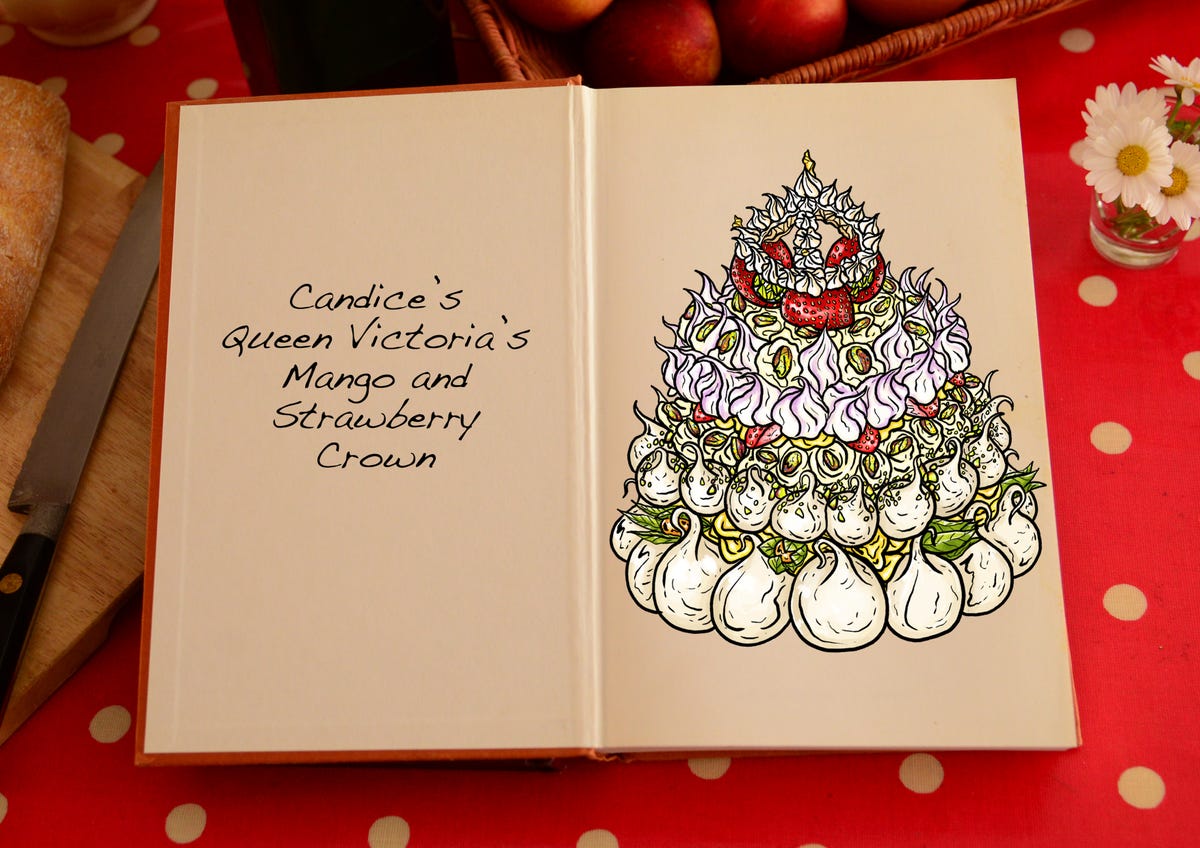
Contestant Candice Brown's mango and strawberry crown from season 7.
Love Productions, Studio HoveyHovey, 39, has been making illustrations for the popular reality show since its beginning in 2010. Black ink delineates the colorful swirls of meringue, crumbles of crust and fruity layers of filling that show up from bake to bake. He shows how icing might drip artfully down the side of a two-tiered cake decorated with foxes and mushrooms, or how rosemary whiskers jut out of the snout of lion-shaped bread. In Hovey's illustrated universe, nothing has ever been underbaked.
On moving to London with his girlfriend that same year, a friend who worked at a TV production company told him about a baking show in the works. Hovey essentially became a runner, sitting in a room with the series director and an editor and assisting them. While he liked the gig, he was also an artist, having worked on murals, live drawing shows and even political cartoons -- street art was having a moment in London.
"I kind of professed my lack of ambition for TV work and that I was actually a budding illustrator," Hovey said about an exchange he had with his bosses. Instead of admonishing him, they went out for lunch one day with the show's other producers, and came back offering him the chance to help create a visual element they felt the show was lacking.
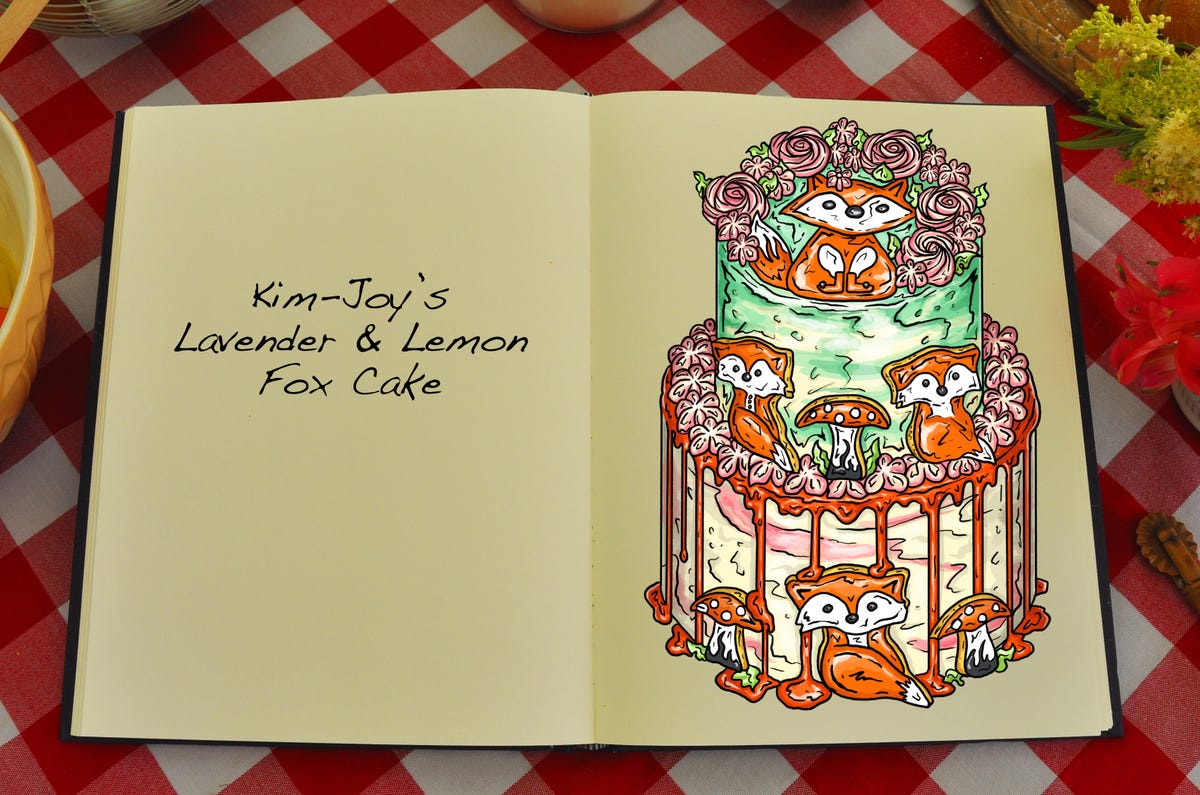
Contestant Kim-Joy Hewlett's season 9 lavender and lemon fox cake.
Love Productions, Studio HoveyIn the evenings and on weekends, Hovey started working on sketches of the usual cakes, cookies and pastries. Quickly, the powers-that-be signed off. And the time he'd spent in the street-art world informed the style of the GBBO illustrations, particularly the use of lots of black ink a la Posca paint pens. The look worked well for graphics that were supposed to look attractive but not overly polished or stylized.
And in that, they've bolstered one of the show's main appeals: the cozy vibes; the joy of amateur bakers making delicious-looking baked goods for the glory of an engraved cake stand trophy, and helping each other along the way with encouraging words and a cheerful thumbs-up. In a world that's often fast-paced and harsh, GBBO is a fuzzy blanket and a warm cup of tea at the end of a long day.
To create the illustrations, Hovey gets photos of the bakes sent to him from the tent and goes back and forth with the production team. He said some of the most fun illustrations can be for bakers who've committed to an aesthetic, like Helena Garcia from the 2019 season, who went all in on spooky-themed bakes like wicked witch apple illusion cakes. Or Kim-Joy Hewlett in 2018, whose creations like orange cat madeleines were just cute, in a word.
As the seasons have gone on, Hovey has also changed the way he's approached the illustrations. In 2016, he went fully digital. He'd started out doing the line work with the black Posca pens and scanning them into Photoshop to add color and text. But after a string of projects, including the Great British Bake Off Colouring Book, it was apparent digital might make life a little easier.
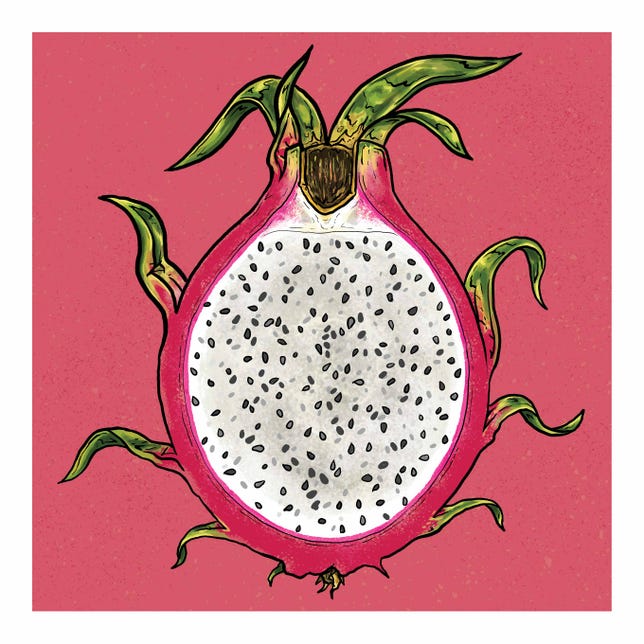
A cross section of a dragon fruit drawn by Tom Hovey. At this point, the artist is fully focused on food illustration.
Studio Hovey"[It was] a good few months of doing black line drawings, and then zooming in, and me and an intern deleting really little paint splatters from the nibs of the pens," Hovey said. Now he uses a Wacom Cintiq tablet, and he created a digital brush that mimics the Posca pens.
Another big change is that he's got a team of three illustrators, which is fitting since he handles illustrations not just for the flagship show, but for others including the American spinoff and Junior Bake Off. He estimates his team has produced more than 3,000 illustrations for all the series so far.
Through the seasons, he's visited the tent a few times. Though there's a family day for the crew, he generally steers clear since his daughter has an egg allergy.
And no, he doesn't much like to bake, and he doesn't like cake.
"Maybe it's just being a greedy person, but I like to make things that I want to eat, and if I don't want to eat cake, then I'm not going to make it."
Hovey has done work for Mastercard and Bloomberg Businessweek, but at this point he's fully focused on food illustration.
He's got a series of fruit slices, rich in color and detail -- you can see every seed in the dragon fruit and every twist and turn in the flesh of the fig. A poster for a band called Idles features an enormous ice cream sundae against a pink background, covered in chocolate and strawberry syrups, topped with sprinkles and raspberries, two perfect cherries and whipped cream. The bottom says "joy as an act of resistance," and it is.
"I never intended to be a food illustrator, let alone a cake illustrator," he said. But as the tent has taught so many, sometimes things turn out a little different than expected.
The Secret Ingredient in 'The Great British Baking Show' - CNET
Read More
Friday, October 21, 2022
Ingredient: Pears - richmondmagazine.com - Richmond magazine
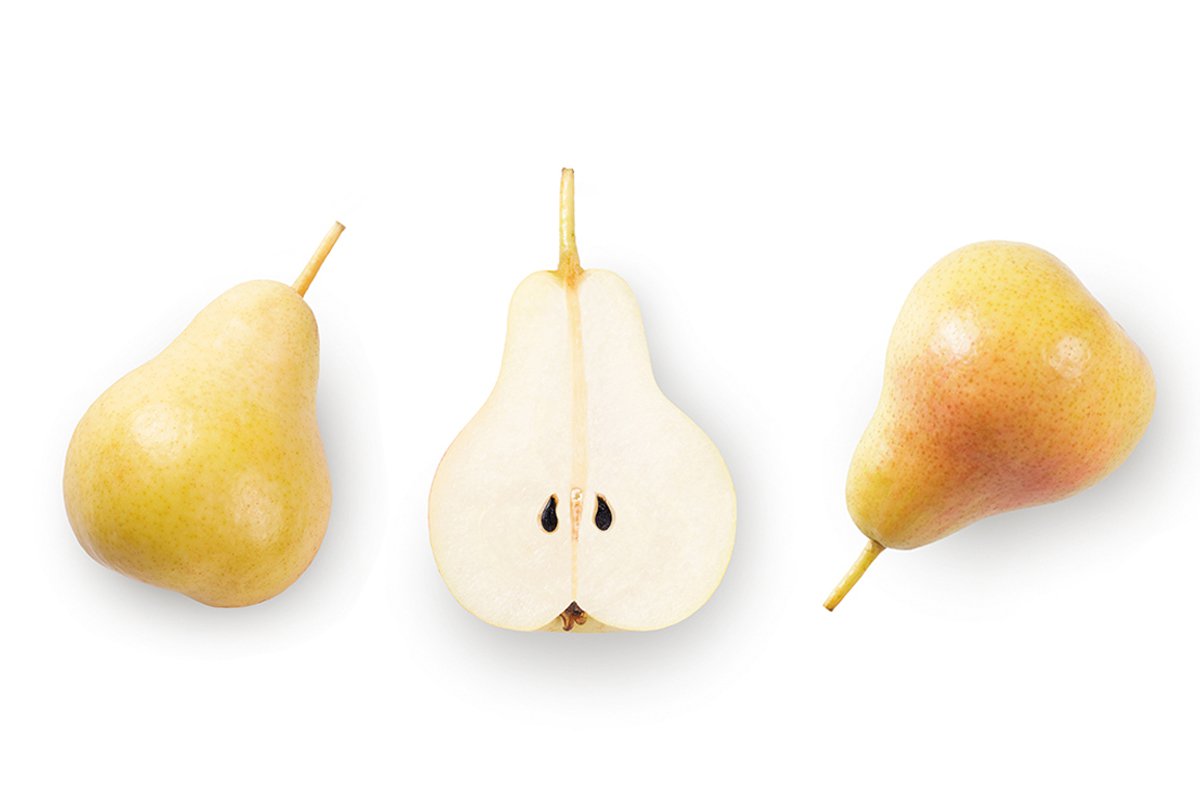
PEAR BASICS
Buying: Look for pears that are firm to the touch. Most importantly, pick pears with a little give right at the stem, a signal that they’re perfectly ripe but not mushy.
Cooking: Soft, sweet pears are excellent in salads and when served raw with funky cheeses, especially blues. They can also be poached in a variety of liquids, from wine to infused syrups.
POWER TO THE PEAR
There are around 3,000 types of pears, including Bartlett, which are soft and juicy; crisp Bosc; and well-balanced Anjou. Peaking in the early fall, pears can be preserved in several ways, including canning and drying, to extend their season.
AROUND RVA
Pearl’s Bake Shoppe: Pearl’s Fall Festival cupcake combines cranberry cake with caramelized pear filling and an apple butter buttercream.
Shagbark: Pears go savory in Shagbark’s brandy butter-glazed chicken, joined by a salad of apricots and pistachios that nestles up to the bird.
L’Opossum: Pears get poached in Chablis at L’Opossum in a seasonal salad, aka a “mélange of chicory, radicchio and baby oak leaf.”
I loved every minute of eating messy, juicy pears as a kid.
—Ben Hill, pastry chef at Can Can Brasserie
COOK LIKE A LOCAL
Pear Upside-down Cake
By Ben Hill, pastry chef at Can Can Brasserie
In his pear upside-down cake, pastry chef Ben Hill of Can Can Brasserie mixes pears with brown sugar and butter to create a sweet, glossy topping for the light and fluffy cake. To serve, Hill plates individually sized cakes with mascarpone ganache, maple-cranberry granola and his housemade vanilla ice cream, but feel free to skip the ganache and granola and go straight for your favorite ice cream.
Pear Topping
4 tablespoons unsalted butter
1/2 cup brown sugar
3 pears, thinly sliced
Melt the butter, add brown sugar and pour into the bottom of a greased 8-inch cake pan. Layer in the sliced pears in a spiral pattern.
Cake Batter
1 1/2 cups all-purpose flour
2 tablespoons baking powder
1/4 teaspoon kosher salt
1 stick unsalted butter
1 teaspoon vanilla extract
2 eggs, separated
1/2 cup whole milk
1/4 teaspoon cream of tartar
1 cup granulated sugar
Cream the butter and half the sugar. Add in egg yolks and vanilla extract. Once emulsified, alternate dry ingredients (flour, baking soda, salt) and the whole milk until everything is mixed. Whisk the egg whites with the cream of tartar in a clean bowl, then add the remaining sugar until you get medium-stiff peaks. Fold that into the rest of the batter in three additions. Carefully layer that on top of your pears, bake at 350 for 30-40 mins depending on your oven. You’ll know it’s ready when the cake springs back when touched. Allow to cool on a wire rack, run a knife along the edge of the cake pan and invert onto a plate to serve.
Ingredient: Pears - richmondmagazine.com - Richmond magazine
Read More
In Jamie Oliver's newest cookbook, you don't need many ingredients to make a delicious meal - WBUR News
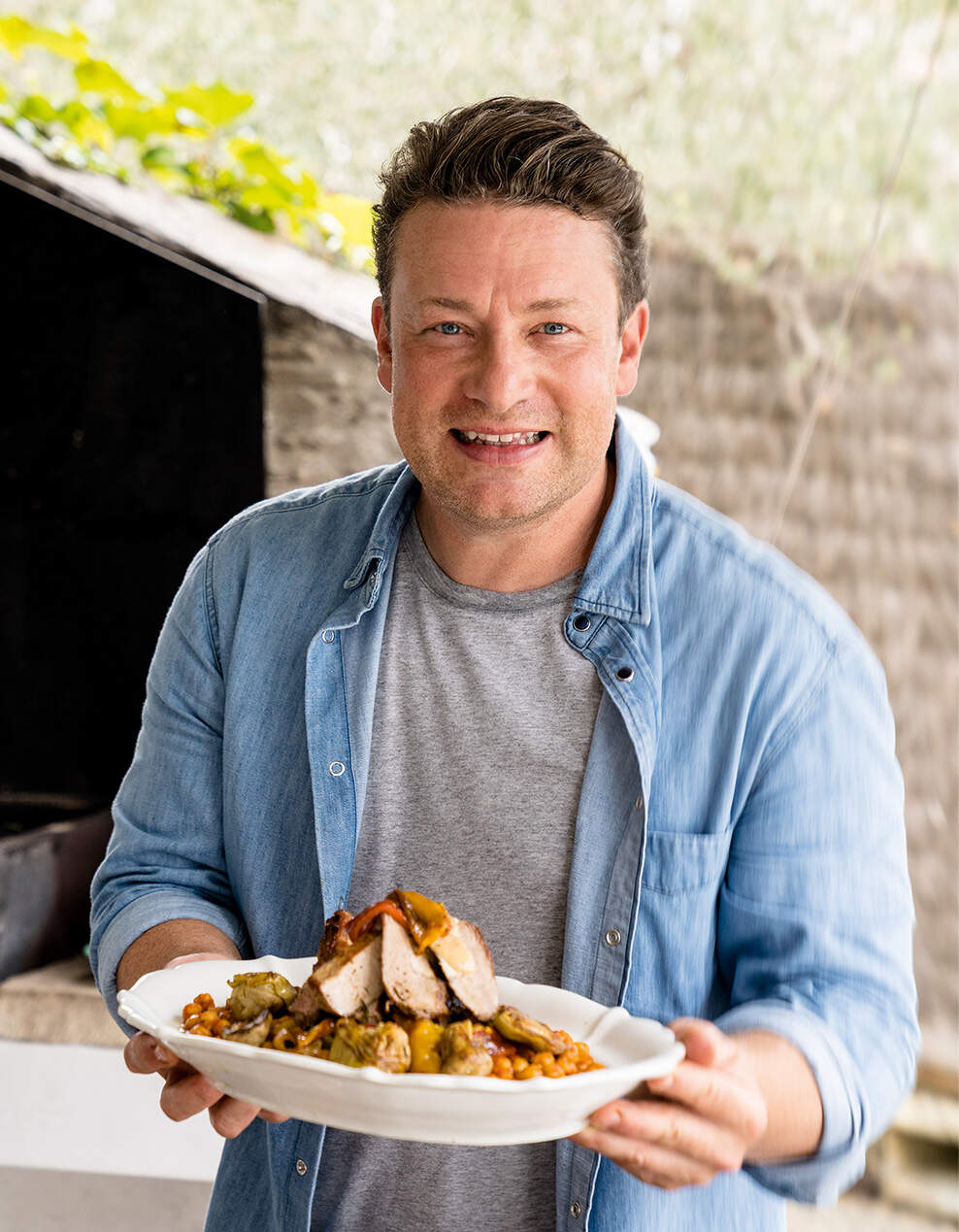
You don’t need a ton of obscure ingredients to cook up a delicious meal. That’s the crux of chef and restauranteur Jamie Oliver ’s new cook...
-
Planning dinner over the past 18 months has been an uneven journey as the home kitchen has adapted to the many changes dictated by unpredic...
-
The former " Bizarre Foods " host recently released a new episode of his YouTube show "Andrew Zimmern Cooks" that'...
-
Camels have an incredible ability to survive weeks without taking even a sip of water. Now, we have a better idea of the secret ingredient ...


